

A resource for those seeking information on organizing and transforming spaces.

There's an App for that!
The mobile app Letgo allows for easy and quick sale of your unwanted items.
Not the One from Frozen

One of the many things we often hear from our clients is that they are busy. Time can be a barrier when it comes to getting rid of unwanted items. While many organizations offer pickups for donations it can be time consuming if you want to sell items. Sites like eBay can sometimes work well for valuable items that are easily shipped. However, large pieces always present a challenge. For a long time Craigslist dominated the market but now there is a new kid in town. Letgo is a free mobile app that is very easy to use. Once downloaded you simply post a picture of the item you want to sell adding a brief description. Since you are using your phone you take and upload the picture basically at the same time. If you allow location services than even that step is taken care of quickly. What’s the catch you ask? Currently, there is no fee to list, buy or sell. In other words everything is free for now (the app is part of the tech bubble phenomenon where your stock price is huge but your company doesn't make a profit). Another option allows you to list the item for free which works well for treadmills and other large items since paying a hauling service to take unwanted items can get pricey. Since people have to come over to pick the item up it is best to make sure they bring enough help to carry the item and a suitable vehicle to take it away. You do need to be comfortable with the buyer coming to your house and if you can, it works best to have the item in the garage or outside when they arrive. Additionally, if you list multiple items try and book all the pickups near the same time as to free up your day.

Interview - Organized Living
Often our clients have big closet challenges and so I thought it might be good to speak with Rebecca at Organized Living about some possible solutions.
Often our clients have big closet challenges and so I thought it might be good to speak with Rebecca at Organized Living about some possible solutions.
Our philosophy is that one’s stuff dictates the terms of the closet system and not the other way around, how does Organized Living differ from a “one size fits all” approach?

Closet systems should be custom to the person’s needs and the belongings they own. That’s why homeowners love the freedomRail system so much! You can move it to fit seasonal needs like more space for your favorite pair of riding boots or a long coat. You can always add components, too. If you have an extensive shoe collection and need a few extra shelves, freedomRail can accommodate that!
I understand professional installation is recommended but what about the design process?
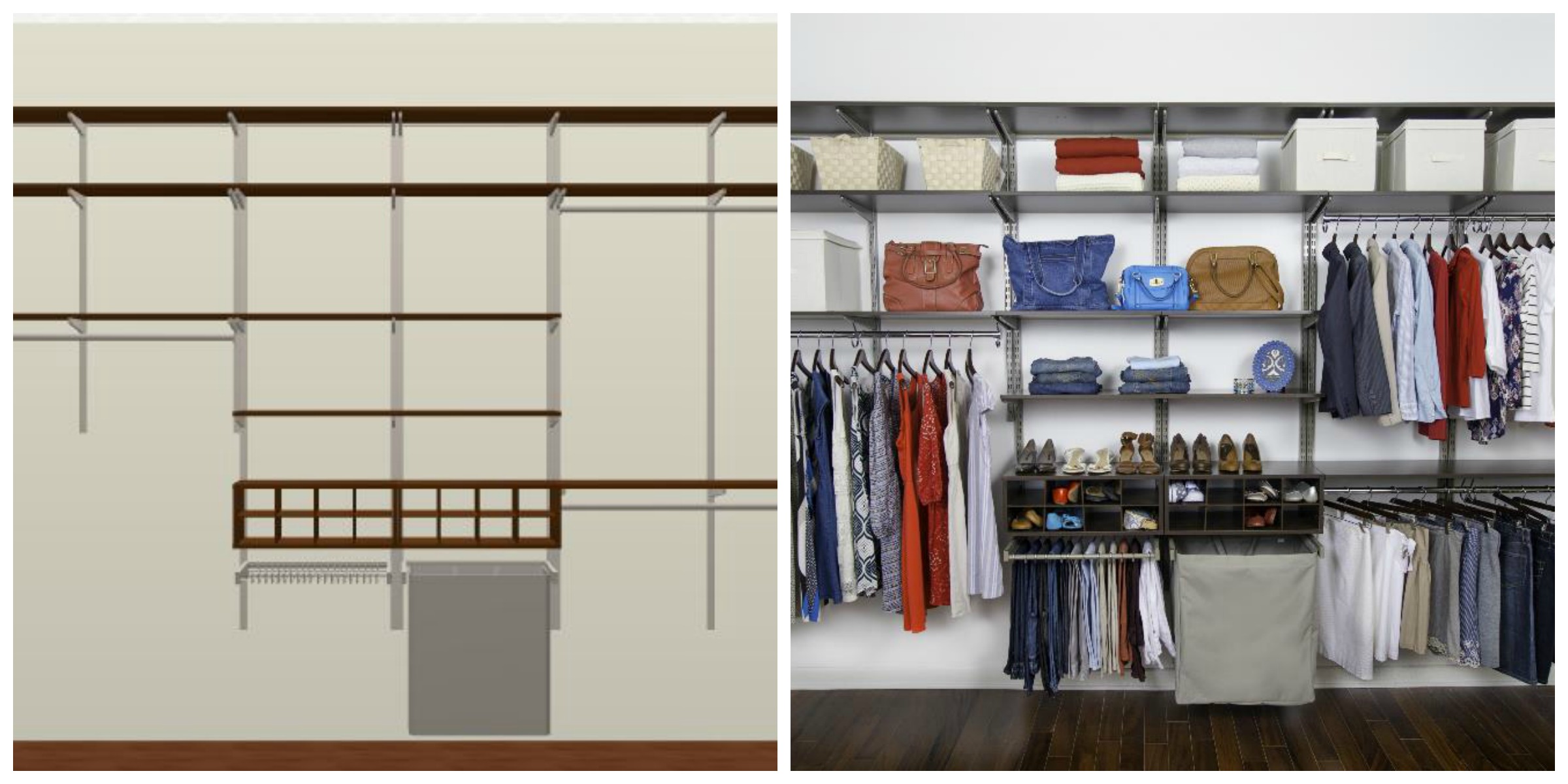
We have this amazing Online Design Tool that allows you to design your own freedomRail closet. You can send the completed design to an Organized Living dealer when you are finished to have them review, order and install your new system.
If my requirements change over the years, how do you handle the need for change or growth?

This is where our amazing freedomRail system takes the cake again. Not only can you move it at any time, you can always add to it. You can purchase components from OrganizedLiving.com or visit your local dealer to get everything you need. The best part about adding or adjusting freedomRail is that you don’t need any tools to do it!
What are the differences between your lines: freedomRail & Classica?

freedomRail is our adjustable closet system. It’s great for active families whose storage need change constantly. Classica is our traditional, built-in closet system that’s great for families that have more defined needs.
In your experience, what area of the home presents the biggest challenges?

We feel like it’s a tie between the kitchen and the garage. They are both areas that have high traffic and have the tendency to become a catch-all. The best way to stay organized in those areas is to have a system in place.
What are the coolest things people have done with your system?

The coolest thing people have done with our system is an entire playroom area. There was an entertainment center and two desks created with the freedomRail. It’s an adorable room and we love that the photo shows how versatile freedomRail is and how it can be used throughout the entire home!
If you want to learn more about Organized Living and the systems we sell, visit OrganizedLiving.com today.

Interview - Marci Klein of Modify Furniture
After visiting Marci's workspace at Modify Furniture, Linda and I had a lot of questions and Marci shared her insights with us.

After visiting Marci's workspace at Modify Furniture, Linda and I had a lot of questions and Marci shared her insights with us.
Why did you name the company Modify?
I chose the name Modify Furniture for several reasons…our furniture is MODern, Modular, and MODifiable.
What do you mean by environmentally friendly?
There are several aspects that go into a product being eco-friendly. The most obvious being the actual materials used. We use aluminum that is 30% recycled content, and sustainable bamboo which is actually not a tree but rather a grass. Bamboo is harvested every 7 years (as opposed to trees which typically take 30 years to grow to harvest) and is considered carbon neutral. Our sliding doors are steel which is also recyclable.
Beyond the actual material, it is important to look at the finishing materials. For example, we use organic powder coating on our aluminum and steel components; they are applied in powder form and do not release aerosol toxins into the environment. Our bamboo is hand finished with a low VOC oil-wax, safe for the environment and the customer alike.
It is also important to understand manufacturing processes. For example, recycled materials that started their life in the USA and were then shipped to China to be broken down, manufactured into a new product, and then shipped back to the USA may not, in fact, be particularly green. That is why at Modify, we opted to do all manufacturing in-house or as close as possible. The few processes that aren't able to do in-house are within the lead recommended 250-mile radius of Bridgeport, CT.
Lean manufacturing is another component to being green. For example, at Modify, we make each piece of furniture to order and stock only a small volume of our colored panels. Therefore, we NEVER have overstock products that wind up in a landfill. We also optimize all manufacturing to result in approximately 5% waste (pretty good by industry standards).
We also flat pack ship our furniture mostly assembled. So a credenza that would take up 85inches x 18 x 40 and require freight to be shipped fully assembled will fit into a box 1/5 that size and can be ground shipped saving space for more products in the truck.
We are constantly investigating new materials and manufacturing methods to work to improve.
Where do you make the furniture, overseas?
Almost all of our manufacturing is done in-house at our Bridgeport, CT workshop. What we don't do ourselves is primarily done within 250-mile radius of our workshop. You can read about our partners in the “Our Gratitude “ section of the website.
From an organizational standpoint, what makes Modify work well in small spaces?

The polychrome modular line is designed specifically to offer a stylish and highly customizable storage solution. The products range from a low media unit/bench to full wall units. They are made with an aluminum frame and are structurally stable without any doors for customers who want to showcase their decorative items or they can opt to have easily removable steel doors to hide unsightly items. As the colored doors are easily swapped, the furniture can be adapted to the customer’s changing tastes and needs:

The back of the unit works in the same way so the furniture can be placed as a room divider or kept open against a wall for ventilation and cord management.
The inside of all units is completely open to offer maximal versatility. I am able to add extra custom shelves based on customer needs.

Our coffee table is one of my favorite products as it has access to storage from all sides and has 36x36 x7 inches of storage inside.

The clean slate desk design offers a unique storage solution (the invisibin™ system) built seamlessly into the top surface to give a clean minimalist look with easy access to writing tools, calculators etc. My Drop-in Accessory line products also fit seamlessly into the desk surface and add a playful, personal, and functional touch.
What made you decide to start your own company?
I believe I have always been a designer and maker at heart. Since I was young, I would daydream about how I would reign in a space to make it more functional, or how I would make a toy that worked better. Growing up with my dad, who was an engineer, a favorite hobby was to work together in our basement workshop, making pinball machines, Snoopy houses, to name a few. Moving into a home and doing our own renovation respired that creative itch and somehow, modular furniture that offers high-end design, with a smaller footprint just seemed to fit.
What is your favorite piece to make and material to work with?
Hmm, that is tough. I have to admit that exploring the unknown and playing with new materials is much more fun that repeatedly making the same piece after I have “mastered” that design. We make a LED light (not yet available online) that incorporates recycled colored glass pieces to play with overlapping colors somewhat like a kaleidoscope. The beauty of this design is that depending on the colors and how I lay out the glass, each one is completely unique.

Guest Post - Golf Season
As spring approaches, many of us look forward to playing golf as much as any outdoor hobby that warm weather allows us to indulge. But with the arrival of golf season comes the challenge of effectively storing and organizing golf equipment. Many struggle to keep their collection of golf gear modest in size and properly stored, creating a daily organizational headache - especially for a spouse or partner that doesn’t play. Here are three straightforward tips to organizing your golf clubs, balls and accessories in a manner that reduces clutter but still keeps you supplied and prepared for the links.
Golf Equipment: How to Reduce Clutter and Organize Effectively
As spring approaches, many of us look forward to playing golf as much as any outdoor hobby that warm weather allows us to indulge. But with the arrival of golf season comes the challenge of effectively storing and organizing golf equipment. Many struggle to keep their collection of golf gear modest in size and properly stored, creating a daily organizational headache - especially for family members that don't play. Here are three straightforward tips to organizing your golf clubs, balls and accessories in a manner that reduces clutter but still keeps you supplied and prepared for the links.
Don’t Collect Golf Clubs
Many golfers develop a habit of holding on to clubs they’ve acquired over a lifetime of play. However, with rare exceptions, old clubs are worth close to nothing. Given the pace with which golf technology advances each year, old clubs quickly become obsolete and cannot be sold for any real value. It’s also somewhat impractical to keep clubs as potential replacements for the set you actively use; the chances of losing or breaking your clubs during play is extremely small. Saving old sets for your children can be problematic as well. Before they hit their teenage years, they’ll need clubs specifically designed for kids, and once they get older they will want clubs of their own that are technologically current. Stick to one set of your favorite, most reliable clubs (USGA rules allow a golfer to carry up to 14 during play).
Exceptions? You may have two putters that you alternate between, or perhaps an extra wedge or hybrid that rotates in and out of your bag. But unless you’re an excellent golfer that plays a wide range of courses, stay away from constantly rearranging your clubs. Keep the clubs that you know you use most on the course and discard everything else. The momentary pain of parting with a club you rarely use will soon give way to contentment about reducing household clutter and committing to a stable arrangement of clubs to play with.
When it comes to older clubs with sentimental value – your mother or father’s clubs, or the first driver you ever owned – you shouldn’t feel pressure to throw these away. But you should only keep those clubs that truly have an important emotional connection to your past. As for storage, they should be considered memorabilia and placed in an area that doesn’t eliminate room for more pressing household needs.
Categorize Your Golf Balls and Keep a Reasonable Amount

There are two categories of golf balls: balls you use on the course, and “shag balls.” Balls that you bring to play with are new, made by elite manufacturers like Titleist, come in slick packaging, cost real money, and provide you with an advantage on the course. They should be stored near your clubs and added to your bag, as needed, before each round. Try to keep around 10-15 of these balls at any given time, and include as many in your bag as you will likely use in a round.
Shag balls are not for real golfing; they’re old balls, or balls made by mediocre companies, or both. Their sole purpose is in practicing your short game – chipping and pitching – either at home or at a local practice facility that allows you to chip around in a designated area. However, as these accommodations are increasingly rare at public courses, you should own shag balls only if you have a yard large enough to practice your short game in. The balls should be stored in a plastic bag or a small duffel, and placed in a dry area near the yard where you practice. You should keep around 20-25 if you practice frequently; a useful guideline is not to keep more than one bag or container of shag balls.
(As for balls to bring to the putting green, you can use the nicer and newer balls that you play with for this purpose. You will only be bringing 3-5 balls to the putting green, there is no chance of losing them, and they will not incur significant wear and tear being used to hit putts.)
Keep Only One Golf Bag and Don’t Over-Accessorize

Golf equipment consists of much more than clubs and balls; golfers also own a bag, gloves, tees, ball markers, and devices that clean your spikes and repair ball marks on greens. Most of these items do not pose an organizational challenge, as they are small and can be stored in your bag. However, holding on to an excess of these items isn’t organizationally beneficial, and will make your bag uncomfortably heavy. Invest in the universally available item that magnetically attaches a ball marker to a small device that also repairs ball marks and cleans spikes. (These are available in any golf shop and frequently come styled with the logo of the course where they’re sold). Hold on to no more than two of these; in a pinch, any coin can be used as a ball marker, and a tee can both repair ball marks and clean your spikes.
The major exception in terms of organizational convenience is, of course, the golf bag itself. Golf bags are awkward objects that can essentially only be stored standing upright in a corner. They have a strange shape and, once filled with clubs and balls, can quickly become quite heavy. The golden rule: one golf bag per golfer in your household, and that bag should be the bag that each golfer actively uses. Keeping old bags can create a clutter challenge that justifies saving an unreasonable number of older clubs. If you’re holding on to a back-up bag in case your active bag breaks, that could mean you should look into replacing it. Golf bags are durable and long-lasting, and if you’re concerned that yours will break soon, it might be time for a new one. (Today’s golf bags are made with much lighter materials, so investing in a newer model may also do your back and shoulders a big favor.)
Golf is an expensive sport, which is why so many golfers are reluctant to throw away old or excessive equipment. But an unreasonable attachment to golf equipment does nothing to help your game and will quickly devour valuable storage space in your garage, basement, or attic. Golfing is, ideally, a release from stress – don’t make it a source of stress and tension by adding clutter to your home.
Andrew Harrison is an obsessive golfer and golf fan who comes from a like-minded family of golf nuts. He has over four years of experience as a professional organizer and has caddied for ten summers at the Country Club of Fairfield in Fairfield, CT.

