

A resource for those seeking information on organizing and transforming spaces.

Interview - Greg Stones
As long time visitors to the SONO Arts Festival, we have also been longtime fans of artist Greg Stones. If you are looking for something original to turn your home into a museum check him out.
As long time visitors to the SONO Arts Festival, we have also been longtime fans of artist Greg Stones. If you are looking for something original to turn your home into a art museum check him out.
What’s your background?
The most important pieces of my creative evolution that inform my work at the moment: I saw Star Wars in theaters in 1977, my parents bought me Crayola crayons at some point, I graduated from Bates College in 1996, I got picked up by Chronicle Books in 2011 because zombies were a thing, and then in 2016 my editor Steve Mockus Jedi mind-tricked Lucasfilm and Disney into letting me write and illustrate a Star Wars book. So there you have it.
How do you work?

I have two ways of working. If I am creating art for galleries and art festivals, I start paintings with no plan whatsoever, and whatever happens happens. It is very improvisational and fun and surprising. If I am working on a book, I lock down a theme and a character that I would like to explore, then sketch pages and pages of ideas that may or may not lead to something worthwhile.
Why did you choose to work in the medium you use?
I like gouache because it is a very flexible and direct medium. It is also super portable, so when I am in the middle of some crazy book deadline, I can bring my work with me to art festivals and hotels and get stuff done.
Your work is what I consider family friendly with a twist, how would you describe it?
I have to say that much of the family-friendliness of my work is thanks to my editor at Chronicle Books, who realized early on that kids really enjoy my books. Left to my own devices, there is a lot more nudity and death by chainsaw in my work, as anyone who has seen my paintings in galleries or at art festivals can attest.
Did working on a Star Wars book make your childhood dreams come true?

To be honest, it never even occurred to me that working on a Star Wars project would be a possibility, so I never really thought about it. I did start to think about it once I got picked up by Chronicle Books, however, because they published four of Jeffrey Brown’s humorous Star Wars books (Darth Vader and Son, Vader’s Little Princess, etc.), which are the books that paved the way for funny Star Wars books everywhere. It was definitely a crazy and fun and scary and exciting process, though. And how cool is it that I got to use all my action figures from the 80’s for work?? Cray cray.
Of your many character creations or Star Wars what do you love working on the most?
At the end of the day, I love painting penguins more than any other character. Don’t get me wrong, working within the Star Wars universe was an amazing thing, but penguins are just so darn awkward and goofy and fun. Plus, they don’t wear stormtrooper helmets, which are the hardest things to paint EVER!!!

Interview - ShelfGenie
Kitchens and closets represent spaces of concern for most of our clients. We spoke with Alex from ShelfGenie to offer possible solutions.
Kitchens and closets represent spaces of concern for most of our clients. We spoke with Alex from ShelfGenie to offer possible solutions.
What are benefits of Shelf Genie as oppose to a full kitchen remodel?

We are a great alternative for someone who is happy with the layout of their kitchen, but frustrated with the functionality. We provide a cost effective instant solution that will create more storage and better access usually with a one day installation. We are also a great option for clients that are thinking of selling their home in the next few years. We improve the look and functionality of the space at a fraction of the cost of a full demolition giving them a much better return on their investment. We also have relationships with door manufactures and wood renewal companies that address the outside of the cabinets.
How does the design process work, does the client have any input?
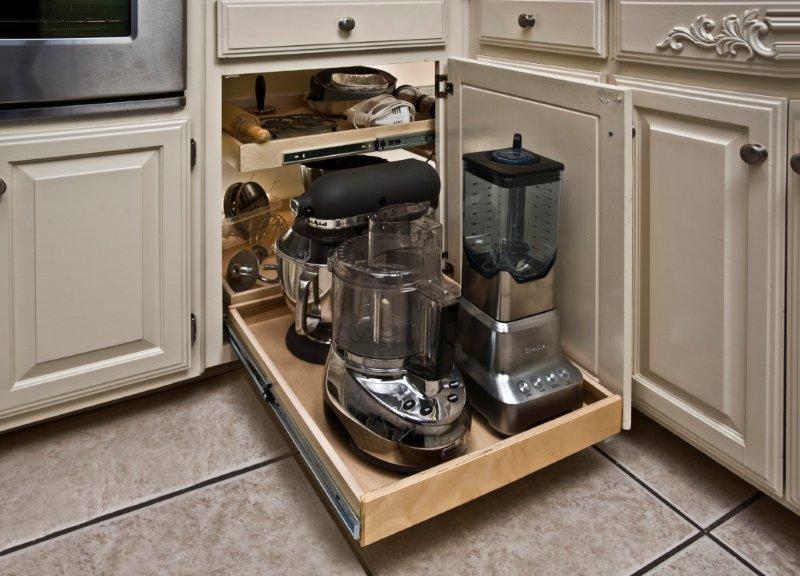
Our consultations are free and are a collaborative process. Client input is required to create the most fulfilling solution. When you call and schedule an appointment, our appointments are fun and we ask you lots of questions concerning how you use your space and what items are you trying to store. What’s driving you crazy? Are you a Costco or BJ’s client? Are you organic or do you have lots of can goods. Do you cook a lot or have cast iron pans. These are all important questions to better know what solutions to create. Once we figure out these elements, we design and price out the solution on sight. No waiting. Once approved, we produce the pullouts in our factory and will complete the project within six weeks. Our installations are usually done in one day.
You mentioned many of your clients are older adults, why do you think that is?
Usually it’s because the kids are out of college and they are starting to focus on their own needs and want to make the space easier to function. Some clients have mobility issues such as bad backs or knees. Pullouts are a very high impact solution for these clients. It allows you to age in place and remain independent.
I associate pull out systems with kitchens do you have solutions for other rooms?

Absolutely, we are not restricted to the kitchen. We work in bathrooms, garages, home offices and entertainment units. Pretty much anywhere pullout shelving systems can be of help. Since our installers are finish carpenters, we can create functional spaces under staircases or convert closets into double pantry areas. We even have put in our pullout shelving in furniture to hold TV’s, DVD’s and CD’s.
What are some of the most interesting or creative projects you have completed?
There a few that come to mind, one was the conversion of a garbage compactor into a functional garbage cabinet. We removed the compactor, built the cabinet with toe kick, put in 2 pullouts (1 for garbage and recycling, the other above it for the garbage bags), ordered a matching door and installed it. When we finished, it looked like it had always been that way.
Another interesting project we did was for a client that had done a renovation of the kitchen space including changing the access to the upstairs. Unfortunately, they had to keep the old staircase as is because underneath was the staircase to the basement. We created a 4 pullout pantry. Since we are all custom, we could make the depth of the pullout as deep as necessary. So, the bottom pullout was 19” deep, the one above it was 25”, above that one 36” and the top one was 5 feet deep. It became an incredibly useful storage space.

Interview - Luke's Toy Factory
As organizers we spend a lot of time talking about "stuff". We always try to direct our clients to experiences, consumables and items of quality. We spoke with Jim Barber at Luke's Toy Factory in Danbury, CT about their fun mission.

As organizers we spend a lot of time talking about "stuff". We always try to direct our clients to experiences, consumables and items of quality. We spoke with Jim Barber at Luke's Toy Factory in Danbury, CT about their fun mission.
How did the company start?
The company consists of 2 father and son teams. Jim Barber and his son Luke, and Mitch Achiron and his son Evan.
Jim runs the business side, Luke does the toy design, Mitch handles package design and Evan does the social media and Public relations.
We all pitch in to build and package the toys.
We got the idea to make toys here in the US after the highly publicized toy recalls from Chinese made toys. In our research we found that almost all toys are made in China, with only a small percentage made in the US. We thought that maybe we could come up with something better. Luke made the initial designs on a computer, we 3D printed them and used these models to launch a Kickstarter fundraiser.
Can you talk about the importance of being made in America especially Connecticut?
Being made in America is a key component of what we do. By making it here, we can monitor production and assure safety. We can use a just in time production model so that we are not stuck with unsold inventory that we must sell cheaply after the holidays. There are over 40 people who have a hand in making our toys, including mold makers in Massachusetts, raw material suppliers in Michigan, and injection molding here in Connecticut. The packaging is also made in CT.
The level of technical expertise that we can draw on from sophisticated manufacturers here in CT is a key component of our success, most importantly with the help of Vanguard Plastics in Southington.
How is the company eco-friendly?
Our toys consist of 30% organic material ( sawdust from furniture factories ) mixed with 10% recycled plastic and 60% virgin plastic. This allows us to replace 1/3 of the plastic that would have been used to make the toy with recycled materials while still insuring product safety.
Now the fun stuff, how do you come up with toy ideas?
Luke had the idea of creating a toy that was more realistic than a "baby toy" but not as difficult to assemble as most toys meant for older kids. Luke has always loved trains, trucks and all kinds of vehicles, so he had a head start. He researched classic designs and and used these elements to create his trucks on a Computer aided design (CAD) program. Then he 3D printed them and we gave them to kids to play with, we used the feedback to refine and perfect the toys.

Which Truck is the most popular?
Our cargo Truck is the most popular. It has all those little boxes to put stuff in!
Any plans to bring new designs to market, or is it a secret?
We are expanding into the educational market, so we are working on some children's books to go along with the trucks, in addition to videos, posters and other fun stuff.
Luke also has plenty more designs on the drawing board which we are working on right now, including a tug boat and train designs.

Book Review - The Things You Can See Only When You Slow Down Part II
As professional organizers we try to read and educate ourselves continually on new ways and techniques to organize, as well as new trends in the industry. The book, The Things You Can See Only When You Slow Down is continually mentioned by our clients and fellow organizers. In that regard, we thought it was worth a second look. The book written by Haemin Sunim discusses mindfulness and “how to be calm and mindful in a fast paced world.” You may ask how this applies to organizing, and we can assure you it has EVERYTHING to do with organizing.
As professional organizers we try to read and educate ourselves continually on new ways and techniques to organize, as well as new trends in the industry. The book, The Things You Can See Only When You Slow Down is continually mentioned by our clients and fellow organizers. In that regard, we thought it was worth a second look. The book written by Haemin Sunim discusses mindfulness and “how to be calm and mindful in a fast paced world.” You may ask how this applies to organizing, and we can assure you it has EVERYTHING to do with organizing.

Mindfulness is about being in the present moment. It is important to not worry about the past or dwell on the future. In our fast paced lives, that is a skill that is hard to do. Think of all the times you said “wish I could get more organized, but every time I try I just feel so overwhelmed.” Or, “this project is hopeless,” or, “I’ll try again tomorrow”. You are not alone. Mindfulness brings patience, therefore we are more kind to ourselves. We realize that things take time and do not happen overnight. We learn to treat ourselves and others with compassion. Mindfulness teaches us to be open-minded. When we are open-minded we explore options we did not consider before.
The book is written in 8 chapters; Rest, Mindfulness, Passion, Relationships, Love, Life,
The Future, and Spirituality. Each chapter opens with an essay, then short messages, then a shorter essay, followed by another series of short prompts for meditation. The book is interesting and easy to read with many outstanding tips on how to improve one’s daily life.
Some of Sunim’s insights are as follows:
p.41 “On a piece of paper, write down everything that stresses you out. List everything you ought to do including minor things-watering plants, replying to emails. The stresses are now contained on a piece of paper, away from your mind. So relax tonight, tell yourself you will go through the list tomorrow, item by item, starting with the easiest. When you open your eyes the next morning, your mind and body will be ready.”
p. 68 “Do not lament that the world has changed. Do not resent that people have changed. Evaluating the present through the memoires of the past can cause sadness. Whether you like it or not, change is inevitable. Embrace and welcome it.”
p. 212 “ Dream big but start small. A small adjustment can have a big effect on your life. For example, if you want to be healthier, then start by going to bed a half hour earlier. If you want to lose weight then start by drinking more water instead of soda. If you have an important project to complete, then start by getting your desk organized”.
The majority of the concepts in the book are simple such as slowing down, maintaining good relationships and having self-compassion. Mindfulness has shown to increase self-control, objectivity and improve concentration, which are all important organizing skills. Truly if we all could practice mindfulness, our stresses would be less and our lives would be more productive, calm, compassionate and full.

Haemin Sunim was born in South Korea. Educated UC Berkeley, Harvard and Princeton. He is a Zen Buddhist teacher a former professor of Buddhism at Hampshire College. His books have sold over 3 million copies.

