

A resource for those seeking information on organizing and transforming spaces.

Reasons Everyone Should Want To Live Clutter-Free
Life is a balancing act. Everyone is faced with making decisions that will result in different outcomes. We live and learn from the trials and errors that life has to offer. When dealing with normal stressors and obstacles, living with clutter shouldn't be one of them. Here are a few reasons why everyone should want to live free of disarray.

Life is a balancing act. Everyone is faced with making decisions that will result in different outcomes. We live and learn from the trials and errors that life has to offer. When dealing with normal stressors and obstacles, living with clutter shouldn't be one of them. Here are a few reasons why everyone should want to live free of disarray.
Reduce Stress
When coming home from a stressful day, the last thing you want to worry about is cleaning the house. Returning home should be your breath of fresh air. However, when your space is filled with clutter, it can be hard to feel at ease. Living clutter-free will help to reduce your feelings of stress and anxiety that you might have felt throughout the day. Your solution should be in using home storage options. Everything you have should belong to a designated home. You will never find items lingering on the floor or counter because there is a specific spot for it. After you use something, put it back to ensure you will never have to worry about things being out of place. In turn, you’ll come home to a put-together, stress-free space.
Less Clean-Up

When you see clutter, it’s like having a mental to-do list constantly running through your head. You will constantly be thinking about everything that needs to be picked up. When items are tucked away after being used, there is no overwhelming amount of clutter, allowing you to have more time to do other things. You will ultimately feel calm in the space you reside in. This should be carried into every area of the home so you are always at peace knowing things are stowed away. For example, you can use baskets in closets, plastic containers for under sinks, and drawer organizers in the kitchen. Everything will be in its home and not sitting elsewhere to be picked up.
More Accomplished

Lastly, living clutter-free will help you to be more energized and accomplished. However, living free of chaos doesn’t happen overnight. You must take a few days to declutter your space to achieve a clutter-free lifestyle. When making decisions about items you own, you will feel in charge knowing that you’re making decisions for your personal well-being. Ask yourself, “Is this item necessary for my life?”, or “Can I live without it?” Asking yourself these questions will allow you to feel in control of your life and the area you live in. Once you have decided to care only for items you cannot live without, you are able to move forward in life and use your energy towards other things you hope to achieve. To find more about the benefits of living in an uncluttered space here.
Living clutter-free will only benefit you if you work towards it. Put things away after you use them, get rid of items you no longer need, and when you buy something new, decide on it carefully. The more you care for the items you own, the more likely you are to put things back into their designated home after you use them. As a result, you will be energized to reach goals and overcome obstacles to live a calm and stress-free life every day.

Guest Post - What Should You Do with Personal Documents?
Piles of personalized mail and paperwork cover our desks, kitchen tables, family rooms and home offices. Short of building bigger piles, is there a way to manage all this? Yes! You simply need to establish a workable solution and strictly follow the process.
Piles of personalized mail and paperwork cover our desks, kitchen tables, family rooms and home offices. Short of building bigger piles, is there a way to manage all this? Yes! You simply need to establish a workable solution and strictly follow the process.
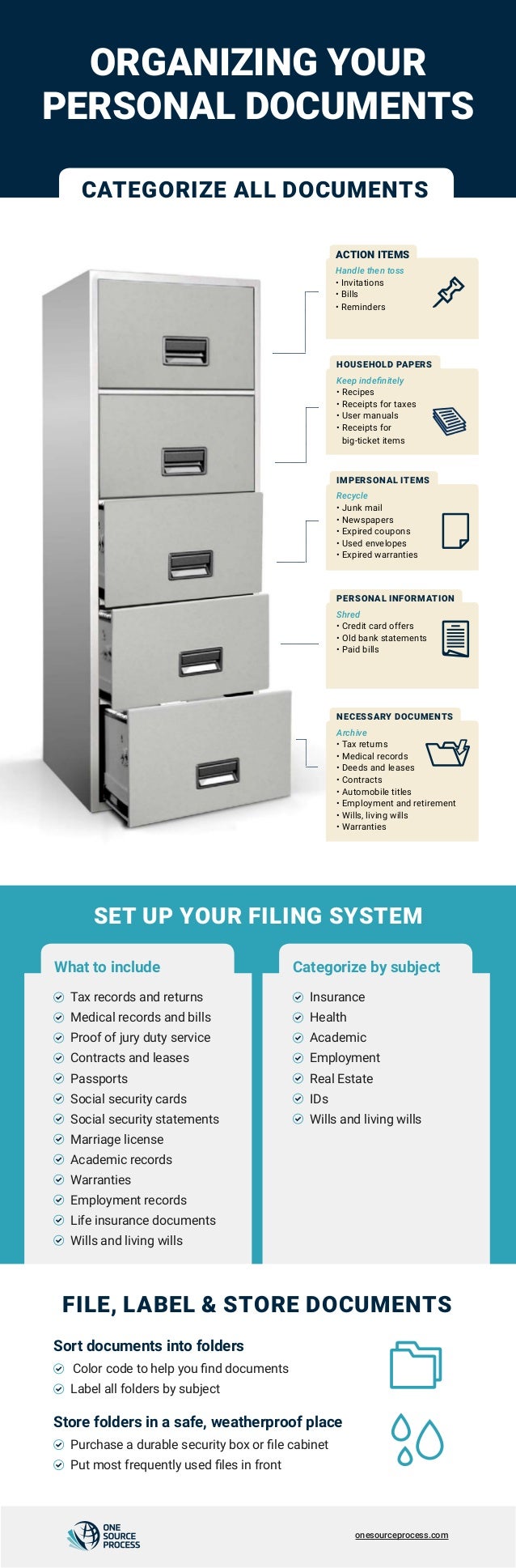
The accompanying infographic, Organizing Your Personal Documents, presents an easy, common-sense method of handling your personal paperwork. It helps you categorize your personal documents by type and action. Some documents should be kept, some shredded and others filed away securely. There are suggestions for creating a filing system, including what types of paperwork to file and how to file, label and store your documents.
Why does this matter? Well, some paperwork you just do not need to keep while others you must keep safe and easily accessible. For example, don’t clutter your home with old bills, expired coupons and the like. But you may need to present your tax returns, social security card, auto title and more on various occasions, such as for a tax audit, new job and car sale, and these must be saved.
Handling your paperwork as you receive it not only helps to keep your home free from excess papers, it also ensures that you hang onto your important personal documents, keep them in a designated place and have them ready to use when you need them. Keep the infographic handy — and file it under O for Organization!

Guest Post - 10 Tips For Staying Organized While Moving: How You Can Simplify The Process!
Planning a big move? Whether you’re moving across the country with the help of a team of full-service movers, or you’re just making a local move to a new apartment or home, we know the process of staying organized while you move can be intimidating. There’s just so much to do!
Well, we’re here to help. We’ve put together a list of the best tips you can use to keep yourself organized while you’re moving. Take a look at them now, and think about how you can use these tips to simplify your moving process – and stay organized!

Planning a big move? Whether you’re moving across the country with the help of a team of full-service movers, or you’re just making a local move to a new apartment or home, we know the process of staying organized while you move can be intimidating. There’s just so much to do!
Well, we’re here to help. We’ve put together a list of the best tips you can use to keep yourself organized while you’re moving. Take a look at them now, and think about how you can use these tips to simplify your moving process – and stay organized!
1. Plan Your Packing Strategy Ahead Of Time, And Start With “Non-Essential” Rooms
If you’re rushing around and trying to pack up last-minute, you’re going to be stressed, frustrated, and disorganized. A move is not usually something that sneaks up on you – generally, you’ll have at least a few weeks to prepare.
So use this to your advantage. Plan your moving and packing strategy ahead of time – and start packing up a little bit of your stuff each day. We recommend that you start with rooms that contain things that are “non-essential.”
For example, you could pack up things that are in your attic or basement, pack up most of the toys in your child’s playrooms, pack up books from your library or living room, pack up the guest linens and other items from your guest room, pack up seasonal clothing from your closet – you get the picture. Typically, the rooms that should be packed up last before your move are the kitchen and bedrooms – you can do these in the last few days before your move.
By taking things slowly and packing up gradually, you’ll have an easier time staying organized – and you won’t feel nearly as rushed, because you’ll have less to do as your moving date approaches.
2. Label All Of Your Boxes Clearly And Create A Packing List For Each One

This is essential for re-organizing your stuff properly once you’ve made your move. You should clearly label each box using tape and a marker, or a label maker. “LIVING ROOM BOOKS,” “GUEST ROOM LINENS,” “DISHES” – you get the picture. Labeling boxes ensures that you can move them to the right rooms once you’ve made your move.
But we recommend going above and beyond just labeling your boxes. You should also create a packing list for each one – this is relatively easy to do. Just keep a pad and paper or your smartphone’s Notes app open while you pack up each box, and note what is going into each box.
Not only does this ensure you know exactly what you’ve packed, it ensures that you know exactly where it is when it’s time to unpack in your new home.
3. Pare Down Your Belongings While You Move With The “4 Pile” Method
Moving is the best time to pare down your belongings, and get rid of stuff you don’t really need. As you pack, we recommend you go through your stuff, and sort them with the “4 pile” method.
Move – These are items that you want to keep and take with you, and will be packed and brought to your new home
Sell – These are items that are valuable, but that you may not need, or may not be worth taking with you. For example, it may be better to sell your couch and buy a new one if you’re moving across the country, due to the cost of shipping such a large piece of furniture
Donate – These are items that are valuable, but that you may not be using – tools or equipment for a hobby you’re not interested in, gently-worn clothing, etc. You can donate them to local charities and stores.
Junk – These are items that are useless and valueless, such as damaged clothing, broken electronics, etc. They’re good for only one thing – throwing away (or recycling).
4. Pack A “Moving Day Essentials” Box With The Things You’ll Need On Move-In Day
This is a great tip when you’re finishing up your move. This box should contain the essential things that you may need to use when you move, such as:
Medications
Toiletries
Extra sets of clothing
ID/credit cards
Important personal documents
Baby necessities
Paper towels and trash bags
Toilet paper
Toolkits
Pet essentials
Basically, anything you think you will need access to on moving day should be put in this box – that way, you don’t have to rummage through other boxes just to find what you need.
5. Make A Change Of Address Checklist To Use After You Move
When you move, you’ll need to file a change of address with the USPS. You should also make a change of address checklist to ensure that all of your personal information is updated with relevant companies – like banking and insurance companies. This list should include:
Employer
State & local tax agencies
Utility companies
Cell phone companies
Home/renters insurance
Auto insurance
Banking/credit card companies
Loan providers
Other financial agencies (investment accounts, IRAs, 401(k)s, pensions, etc.)
Magazines and subscription services
Clubs and organizations
Doctors, dentists, vets and other service providers
Online shopping websites like Amazon
If you change your address with every relevant company and organization as soon as you move, you’ll minimize the risk of missing an important piece of mail.
6. Get Your Old (And New) Utilities Squared Away Before Moving Day
Make sure that you’ve contacted your utility companies including water, gas, electricity, and cable/internet before your move. Cancel your service on your moving date at your old home – and make sure that you’ve set up service at your new place of residence before you move.
Being proactive about this ensures you avoid any double billing or paying extra for services you don’t need – and also ensures that your new home is fully hooked up with gas, water and power when you move in.
7. Make Sure You Have All The Packing Supplies You Need
When you start packing up your home, make sure you’ve got all the packing supplies you need, including:
Sturdy cardboard or plastic boxes of various sizes
Packing tape
Markers
Scissors
Packing material like bubble wrap or foam pellets
Plastic wrap
Moving blankets for furniture and electronics
If you’re short on supplies, you can always purchase more from retailers like U-Haul, Home Depot and others. You can also often find used, discounted boxes and moving supplies on websites like Craigslist if you’re on a budget.
8. Keep All Of Your Moving Paperwork In One Place
The process of moving can create quite a bit of paperwork – from moving estimates to correspondence with utility companies, home inventory sheets, moving checklists, information about your new home, receipts… you get the picture.
To keep these documents organized, we recommend keeping them in a single binder or folder that you’ll keep with you during – and after – your move. Keeping all of your documentation will ensure that the process goes smoothly, particularly if there is a dispute or problem with your moving company.
9. Have A Realistic Unpacking Timeframe (And Stick To It!)
Once you move, create an unpacking timeframe and start working immediately, but at your own pace. Maybe you think you can handle unpacking just 1-2 rooms per day, or you’re looking to get your entire place unpacked in just a week – that’s up to you.
Setting a time limit that’s reasonable will help you stay focused and motivated. Don’t be unrealistic, though – you’re probably not going to get through unpacking a 3-bedroom home in just a few days! Give yourself some leeway, and be realistic about the pace at which you can work.
10. Focus On Organizing Your Stuff While You Unpack – Create An Organizing Plan!

You should do your best to keep your stuff organized and store it properly while you unpack – don’t just unload it wherever it fits. You should create an organizing plan while you’re unpacking.
This will let you identify areas of your new home where you may need additional storage, and then you can make a list of all the things you’ll need to organize your stuff properly.
Stay Organized With These 10 Simple Tips For Moving!
Even in the best of times, moving is still time-consuming and stressful. But with these simple tips, you can make things easier on yourself – and simplify the process of packing, moving and unpacking. Take another look at them now, and think about which tips you can use during your move.
Author Bio: Tom Masters is a moving specialist working with A-1 Auto Transport. They specialize in moving people within a state in the USA from state to state and internationally.

Guest Post - 15 Ways to Maximize Small Spaces Based on the Lagom lifestyle
With the new year right around the corner, it’s a great time to consider de-cluttering, organizing and re-evaluating the belongings in your home. This exercise will free up space, ease your mind and help you focus on what you really use and enjoy in your home.

www.turbotenant.com
With the new year right around the corner, it’s a great time to consider de-cluttering, organizing and re-evaluating the belongings in your home. This exercise will free up space, ease your mind and help you focus on what you really use and enjoy in your home.
However, de-cluttering to some may seem easier said then done, especially if you have a smaller home or apartment. Fortunately, using the Lagom lifestyle concept as a guide can help you make decisions on what stays and what goes. The Swedish word ‘Lagom’ means just the right amount - not too much, and not too little and is all about creating a better, happier and more balanced life.
While there is no one way to live this lifestyle, the goal instead is to find a balance. If you are interested in beginning this transition, TurboTenant rounded up some general tips and 15 easy ways for organizing small spaces using the Lagom method. Most of these can be done on a daily basis and are a different way of looking at your space to find balance.
1. Everything Should Have a Designated Space
If you can’t find a permanent home for all of your belongings, that’s probably a good sign that you should get rid of it
2. Purge Often and Refuse Gifts
Every month, you should go through your home and evaluate each room and the objects it contains. If you haven’t touched it since the last time you did your sweep, it’s time for it to go.
3. Pick Up Every Day
In order to avoid becoming overwhelmed, it’s important to pick up after yourself every single day.
4. Store Your Appliances on a Bar Cart
If you are living in a small home you most likely lack many outlets. Take turns bringing out and using your appliances but keep their permanent home on a bar cart to save on storage.
5. Add a Towel Rack to the Side of the Fridge
Repurpose free space on your fridge by installing a towel rack and small shelves.
6. Reuse Six-Pack Container for Sauces
With a small fridge, you don’t have room for cramming your fridge door with sauces and condiments. Reuse beverage six-pack containers to store the sauces more securely and take up less space.
7. Try Striped Wall Decor to Trick the Eye
Adding vertical striped wallpaper can make a room appear taller, while horizontal stripes can make it seem wider.
8. Use a Blanket Hanger
Reuse a lady as a way to display your throw blankets and add a stylish decor piece to your home.
9. Invest in Multi-Use Furniture
Although some pieces may be pricier, invest in storage or other multi-use furniture pieces to salvage space in your home.
10. Use Hanging Totes as Laundry Baskets
Hang laundry totes on your closet door to keep items off the floor.
11. Install a Shoe Hanger on the Back of a Door
Hide your shoes behind a door to save on space and organize simultaneously.
12. Add a Bookshelf to Your Headboard
Installing a bookshelf above your headboard is an easy way to add a homey touch to your bedroom, as well as ensure your book collection is kept off the floor.
13. Add a Pegboard to the Back of a Door
Install a pegboard on the back of the bathroom door, and add hooks and small shelves for storage.
14. Install a Sliding Medicine Cabinet
Put up a medicine cabinet in place of, or in addition to, the typical wall mirror and add a sliding mirror component to access supplies and see your reflection.
15. Hang Products on Your Shower Rod
The curtain rod can hold more than just the shower curtain, so make full use of its potential by adding metal clips between the rings where you can hang your bath products and save space on the shower floor.
By using the appliances, space, and furniture in your home a different way you too can find balance and maximize the smaller space in your home for the better.
Author Bio: Stacy is a San Diego based writer who covers organization, DIY and home decor. When not writing she loves cooking and traveling.

