

A resource for those seeking information on organizing and transforming spaces.

5 Remodeling Ideas for A Clutter-Free Kitchen
If you desire a clutter-free kitchen that is more conducive to your lifestyle, consider these five kitchen remodeling ideas.

Tiny kitchens don’t seem like a bad idea in theory. When you think about it, how much space do you really need to cook a meal? It turns out that you actually will need more than expected.
Many times, having a tiny kitchen can be more difficult than anticipated. After all, there are a lot of things that go in the kitchen that we don’t realize. From small appliances, a gadget for every need, plus food and dishes for the entire family.
Having a tiny kitchen means that space gets easily cluttered, provides limited space for cooking large meals, and prevents you from being able to socialize and gather in the kitchen.
If you desire a clutter-free kitchen that is more conducive to your lifestyle, consider these five kitchen remodeling ideas.
1. Flooring

Flooring can make or break a cluttered look. Even if everything is completely organized, if the floor is busy, a small kitchen will still look cluttered. Consider simple flooring like vinyl kitchen flooring in a solid color. We will talk about colors down below, but simple colors or patterns when it comes to flooring are best for a clutter-free kitchen. Flooring is a vital part of tying a kitchen all together, making the space usable, and easier to clean.
2. Organization
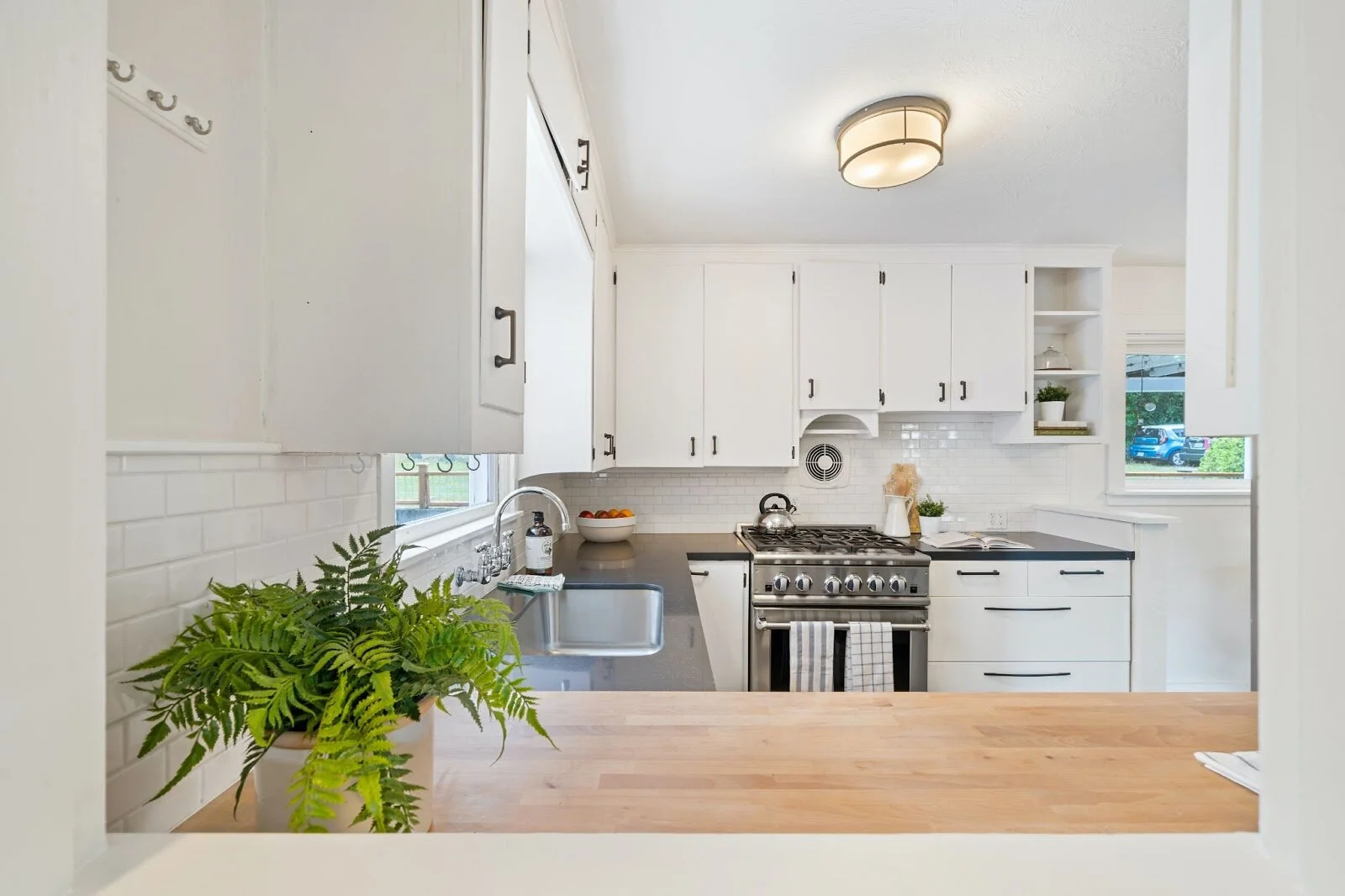
Let’s face it-- if things aren’t organized, they are always going to look cluttered. When remodeling your kitchen, including elements of organization is key. Maybe you choose taller cabinets so that more things can be off of the countertops, or you could remodel an unusable space and make it into built-in shelves for better storage.
Another idea is to rearrange the order of the kitchen. For instance, for maximum efficiency, the sink, the fridge, and the stove should be in a triangle shape. Having everything in the best place possible can really help with clutter because you no longer have to keep things near certain areas for convenience.
Keep in mind to use every little space you can from additional storage on an island to the space above the fridge. Organizations can be implemented in a variety of ways.
Regardless of the layout of your kitchen, there is always room for improvement using remodeling when it comes to organization.
3. Fixtures

Remodeling your kitchen to have more minimalist fixtures can be a simple upgrade to make your kitchen look clutter-free. Fixtures include everything from lighting and faucets down to the drawer pulls and handles on the cabinets. Be sure that at the end of your kitchen remodel that you replace all the fixtures to update them. Choose fixtures that have simple lines and are the proper size to avoid a cluttered look. Don’t forget to have plenty of light to make the space feel more open.
If you don’t have a window, consider having a few different light sources like different combinations of an overhead light, under cabinet lighting, or pendant lighting.
4. Colors
Colors, patterns, and textures do a lot for the look of a space. When remodeling your kitchen, go with light colors to reflect light and simple, classic patterns to avoid the cluttered look. Add a subway tile backsplash for a quick remodel project that will bring your cluttered kitchen to life. Also be sure that the look of fixtures, walls, backsplash, cabinets, and flooring is all cohesive so that the eye isn’t drawn to as many places at once giving the appearance of clutter. You could even consider going with a monochrome look where everything is different shades of the same light color. For instance, shades of gray, white, or beige.
5. Open Up Space

One of the biggest things you can do to remodel and create a clutter-free kitchen is to open up space. If there is a wall to take out or additional space in the dining room that you can use, you should consider opening up that space. Adding more space in an area decreases the look of clutter because things can be spread out more. If you can’t gain any more space in the kitchen, then consider creating flexible spaces.
Flexible Spaces
Flexible spaces are exactly how they sound. Spaces that can be used for multiple purposes. One flexible space that is common in the kitchen is a kitchen island. Many larger kitchens have permanent kitchen islands, but even if you don’t have space for a traditional kitchen island, a prep cart can do wonders for creating more space.
Additionally, you might add a countertop and cabinets in the dining room which can be used as a prep station, a dining bar, and storage all in one. When remodeling your kitchen, think about how you can create flexible spaces that can help declutter and open up space.
Need Help Decluttering?
Achieving the goal of having a clutter-free kitchen can seem like climbing a mountain. If you are struggling with decluttering, call House to Home Organizing, your expert in home organization. They are ready to help!

Simple Ways To Make Your Dressing Room More Organized
Having a dressing room is a fantastic asset when it comes to organizing your home. A separate space that is dedicated to your clothes and accessories will free room elsewhere in your home as well as helping to keep everything in one place, saving you time when you’re getting ready.
However, it can be overwhelming to know the best ways to organize your dressing room, so here are a few simple tips that will work for dressing rooms of any size!
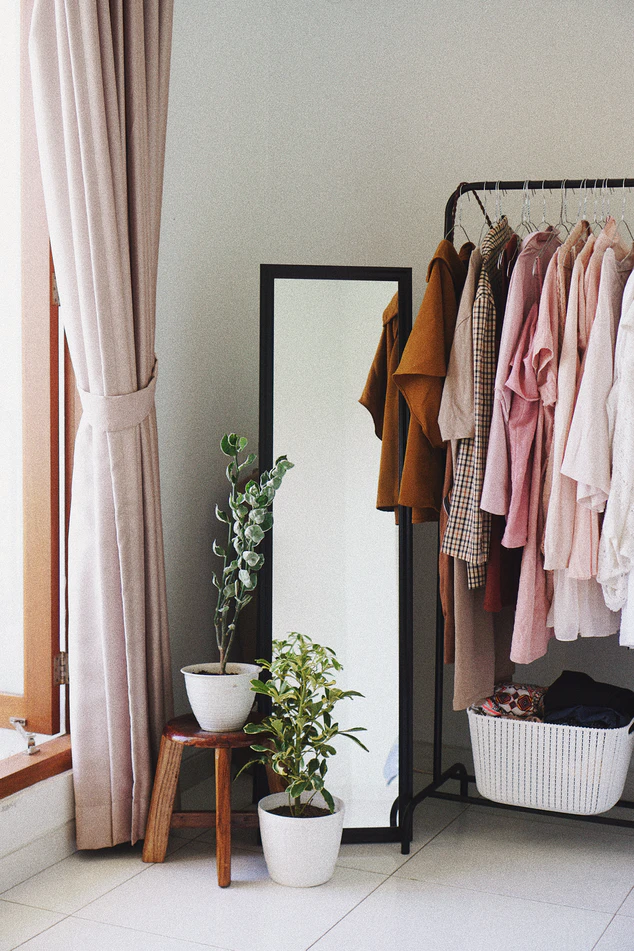
Having a dressing room is a fantastic asset when it comes to organizing your home. A separate space that is dedicated to your clothes and accessories will free room elsewhere in your home as well as helping to keep everything in one place, saving you time when you’re getting ready.
However, it can be overwhelming to know the best ways to organize your dressing room, so here are a few simple tips that will work for dressing rooms of any size!
1. Keep The Floors Clear
One of the simplest things you can do to keep your dressing room organized is to keep the floors clear. Having shoe boxes, storage boxes or general mess on the floor can make the space feel so much messier than it normally would be, so keeping them stored away elsewhere and decluttering is the best option.
When you get into the habit of keeping things on the floor, it will be much more difficult to keep things tidy, so doing a bit of a reshuffle and finding space for things in cupboards or wardrobes, rather than the floor, is the best option.
2. Close Things Off With Doors
Having open wardrobes can look great when you stay on top of your organizing, however for some people, having closed doors is a much better option. This is a great way to block off anything in the wardrobes to keep things looking really nice and clean.
With open wardrobes, it can often be tempting to organize things in a way that look good, but it may not be very functional when it comes to finding what you need. So, having doors is the best of both worlds as you will have a beautiful space and you can also organize your things however works best for you without worrying how they look!
3. Install A Wall Shelf
Installing a wall shelf works particularly well for a smaller dressing room, as you gain so much extra space that you might not otherwise have. If you have some space on the wall, look at installing 2-3 shelves with a decent amount of space between them.
You can use this space to display some of your most prized possessions, such as your favorite shoes or handbags. Not only will this be a design feature but it will also free up space elsewhere. This is also a fantastic opportunity to accessorize, with wall art prints, artificial flowers, plants or candles.
Final Thoughts
Life is so much easier when your dressing room is organized. You will save so much time as everything should be easier to access, so it is definitely worth spending some time to get organized and you will continue to reap the benefits.

8 Decluttering Secrets for an Organized Home
Here are some decluttering secrets you might find helpful in creating a clutter-free living space:
Declutter – the word would spike terror in someone like me!

Although I would love to keep my place decorated to the nines, I just can’t. I am sure there are many out there in the same dilemma as me. According to National Soap and Detergent Association, getting rid of clutter will eliminate 40% of housework in an average home.
Moreover, a study by Cornwell University says that stress caused by clutter can trigger avoidance and coping strategies. These include incessantly consuming junk, over-sleeping, or binge-watching Netflix. This is not the kind of life you deserve.
Whether we like it or not, a kitchen counter stacked with dirty dishes or a basket loaded with unfolded laundry can be as distracting as a toddler throwing tantrums. If you are done with this life and want to flip the scenario, this blog is a must-read.
Here are some decluttering secrets you might find helpful in creating a clutter-free living space:
1. Start small
No matter how much you have to organize, it is essential to start with baby steps. A weekend-long organizing project when you have a family and a timetable and a life all at the same time is never a good idea.
So, start small. Invest in hooks, under-bench storage, and catch-all trays. This is to make sure the smallest of items, like keys, have a place. Small wins are colossal in a decluttering game.
2. Toss away the “one in, one out” rule

Many minimalists stick by the one in, one out rule. It regulates that you have to declutter something of the exact nature every time you bring something new.
It sounds cool in theory. But honestly, it encourages mindless guilt-free purchasing. You will supposedly declutter something when you get home. It would be apt to term it the bandaid approach. You may end up with a clean space, but it doesn’t teach you how to live with less. Seeking assistance from a clutter-busting service may be your next best shot.
Instead, practice on the “zero in, one out” rule if you really want to declutter your house.
3. Look at your home as a guest
This is one of the most potent tips you could ever find.
Imagine you are a guest staying at someone’s place. We tend to keep things where we found them in neat order. Plus, we don’t pile stuff on the floor when looking for something particular. You carefully rummage through stuff to find what you are looking for and don’t create a mess.
This simple tip can help to keep your home tidy.
4. Be smart with storage

Take a long, hard look at the number of bins or containers you use to keep stuff. If you feel about buying more containers or bins, the problem is not about the storage space. Instead, it is about the number of things you have.
Slim down the things you have in the existing baskets and boxes before hitting stores to buy new containers.
Then, reassess your storage needs. Buy more storage boxes and ensure that everything stays in its place. Incoming mail should remain in the basket on the countertop. Similarly, the TV remote will never get lost if there is a holder to keep it.
5. Always clean when you are done
Call this a room reset.
If you begin following this tip, you will be surprised at how much time it saves. For instance, before you hit the sack, try to keep extra things at their places. This will only take a few minutes if you are trying to move towards minimalist living.
A few minutes invested every day to keep the space tidy will give you a surprisingly vast amount of extra time. For further efficiency, you can hire a junk removal service like the Super Bee Disposal to handle the task for you.
6. Create a cleaning kit
No one can argue against the benefits of a clean home. Take some time to collect the cleaning supplies you usually use. Store them in a central location of your home for instant access. You can keep them in your linen closet, basement, or a lower cabinet in your kitchen. Find a large basket or a tote to keep all the cleaning supplies.
When you put them all in one place, the number of cleaning materials you have will surprise you. On the contrary, cleaning supplies all over the house doesn’t give you the proper insight into all the things you have. Consequently, people end up buying more than their requirements.
7. Follow the “30 Day” rule
The 30-day rule could be a blessing in disguise for those who religiously follow it. It implies not buying any oversized or expensive item within 30 days. If you still need it after that, go for it. The whole point of this rule is to give yourself some room to breathe. Impulse buying could lead to a budget disaster, not to mention the clutter in homes.
While you are on the 30-day break, you can question yourself if you actually need this big-ticket item. Does it make sense? Can you live without it?
8. Don’t keep broken stuff
Who does that! Right?
Well, you might not know, but you may be keeping broken, stained, or torn items. We tell ourselves that we will fix it and throw it in our closet. Over time, a pile of clothes rises on it, and it goes out of our minds. That pending fixture never comes. And we end up with unnecessary clutter in our houses.
If you need it and have a solid determination to fix it someday, you better store it in a box. Add this errand to your to-do list. Or the next time you go out shopping, find a replacement and let go of the broken items.
Parting Thoughts

Decluttering is a chore. It takes time and adequate planning to keep your place prim and proper. Experts recommend that you keep all distractions at bay when you are on a mission to remove clutter from your home or workplace.
Plus, make it an ongoing endeavor. This way, you won’t have to skip your work or friends’ hangout for a mission clean sweep.
We hope this all makes perfect sense. Let us all get to work!

Guest Post - Different Degrees of Clutter vs. Hoarding
It’s not uncommon to have some clutter lingering in different areas of your house. It might be a small collection of things taking up space, like a cluttered attic. Or, it could be a room that looks untidy, filled with items that aren’t in their place or don’t need to be there.

It’s not uncommon to have some clutter lingering in different areas of your house. It might be a small collection of things taking up space, like a cluttered attic. Or, it could be a room that looks untidy, filled with items that aren’t in their place or don’t need to be there.
A little clutter isn’t necessarily a bad thing. Maybe you just haven’t had time to clean, or maybe you’re comfortable with leaving things alone in an attic or basement.
But, there may also be an underlying psychological effect causing your clutter. If it gets out of hand, that might even lead to hoarding.
With that in mind, let’s look at why you might be okay with too much clutter, and what to do when it becomes a problem.
What’s Really Causing Your Clutter?
Sometimes, clutter comes from indecision. Bringing things into your home and leaving them in a certain place could be the result of not knowing what to do with them. Other times, clutter builds up because you’re not ready to let things go. Maybe they have a sentimental value, or you’re putting too much emotional weight on them.
If you dig deeper into those causes, you can probably see that there is a psychological attachment. For some, it’s indecision. For others, it might be a fear of letting go of something familiar. Other underlying emotions that can contribute to clutter include:
Uncontrolled impulse purchases
Memories
Fear of needing something in the future
Guilt
Obligation
Hoping for a change
Unfortunately, too much clutter can also contribute to psychological issues. It can cause stress, make you feel inadequate, and can even distract you from things you’re supposed to focus on.
How to Know When Clutter Becomes Hoarding
If the beginnings of clutter can quickly become a problem, what happens when it gets worse?
Most people have heard of hoarding, but where is that line crossed between a cluttered home and one that is overflowing with “stuff?”
Hoarding simply takes the psychological effects of clutter to another level. The American Psychiatric Association recognizes Hoarding Disorder as a real problem when someone excessively saves items that would have no value to others. Some of the most common behaviors and signs of this disorder include the inability to get rid of things (even things like food containers or what others might consider trash), and extreme stress or anxiety about throwing anything away. If someone has a buildup of clutter that causes rooms of their home to become unusable/unliveable, it has gone into hoarding territory.
Everything from stress to OCD, and the factors listed above, can cause someone to become a hoarder. Whatever the case, hoarding can cause a lot of damage to your home. You might start to experience:
Vermin infestation
Mold growth
Plumbing damage
Pet damage
Structural damage
Hoarding can cause you to feel anxious about your possessions. You may even realize that you have a problem but aren’t willing to let things go. Because of this, it’s not uncommon for those who hoard their belongings to avoid getting help or the treatment they need. Recognizing the signs, even understanding that your living conditions are unstable because of the extreme clutter, is the first step in getting help for a hoarding problem.
Clear the Chaos and Build Organized Habits
If you have mild clutter in your home, consider why you might be avoiding it. Cleaning up and creating more space can give you a sense of freedom and take away some of the weight that clutter is causing. Choose to put some things in storage if you can’t let go. Additionally, utilize corners, buy organizers for your items, and use elevation to your advantage by putting things on shelves or tables.
If your cluttering problem has gotten worse, you may be dealing with Hoarding Disorder. Self-help starts with recognizing you need to make a change, but that isn’t always easy. If necessary, seek support.
Hoarding is often the result of underlying psychological issues, and a therapist, counselor, or support group can help you to work through those issues. It will be easier for you to manage your thoughts when they do and to start to get rid of the things you don’t need once and for all.
Author Bio: Noah Rue is a freelance writer.

