
A resource for those seeking information on organizing and transforming spaces.
How Better Organization Can Make a Medical Office More Efficient
Organizing a medical office is complicated. You can have excellent staff and capable doctors, as well as perfectly good equipment, and still feel like something fundamental is missing. The problem isn't always a lack of effort, but rather a lack of proper planning and organization. Luckily, this is fixable. Minor improvements do count the most because sometimes making even one aspect of your workflow more convenient can have a tremendous impact on everyone working in your building.
Organizing a medical office is complicated. You can have excellent staff and capable doctors, as well as perfectly good equipment, and still feel like something fundamental is missing. The problem isn't always a lack of effort, but rather a lack of proper planning and organization. Luckily, this is fixable. Minor improvements do count the most because sometimes making even one aspect of your workflow more convenient can have a tremendous impact on everyone working in your building.
Put Frequently Used Items Where The Work Happens
If you want to improve organization, the first thing you need to do is walk through your office and pay attention to where staff members physically go during an ordinary appointment. You will discover many useful things if you pay attention, even for a little bit. For example, you may discover that something used twenty times a day is sitting in a cupboard. Why would something like that be stored in a cupboard? Move it if possible. There isn't much value in preserving a bad arrangement because it's familiar.
You can also create small, sensible stations instead of one enormous supply cupboard. A treatment room might have its own clearly labelled essentials, while reception keeps the paperwork and stationery it handles constantly. This alone will likely reduce the number of unnecessary walks across the office. Five minutes saved here and there matters a lot in healthcare.
Give Patient Information One Clear Home
Patient information tends to multiply. There are referral letters, consent forms, medical histories, appointment notes and documents waiting to be scanned or filed. Many of these are already kept electronically. However, some information is in folders and some temporarily on a desk. In that kind of system, staff have to remember the office's habits before they can find anything. That's not a good system, especially for newbies.
You can combat this friction by choosing one clear place and one clear process for each type of information. If a document needs scanning, decide where it waits before scanning. And what happens immediately afterwards? If something requires a doctor's review, make that status obvious. A straightforward naming and filing convention also helps.
Build Appointment Buffers Around Some Tasks
A schedule can look full while being completely impractical, and that’s the main cause of friction here. If every appointment is booked back-to-back, there isn't much room for the work that surrounds the consultation. After every appointment, notes need finishing. In some cases, rooms need preparation. Doctors need to check referrals and occasionally a patient needs more time. You can’t just rush them out. Pretending these aspects of healthcare and these tasks don't exist won't make them disappear.
You need to carefully examine what happens between appointments. From there, you can build small buffers where they're useful. For example, you might have to reserve certain periods for longer consultations. You might need to make more time for equipment preparation rather than filling every available minute.
This is particularly important when your office handles services that involve several stages. If a patient is coming in for ultrasound in Wollongong, for example, your schedule needs to account for the actual journey through the service, not just the minutes when the patient is physically being examined.
Make Handover Notes Difficult To Misunderstand
Are you aware of how much office time disappears into clarification? Someone says they left a message. Someone else asks whether the doctor saw it. Then a third person appears and that person isn't sure whether the patient was called back. Nobody has done anything wrong because this sometimes happens in a dynamic workplace. But at the end of the day, the information has become a little foggy.
You can create a simple handover method that works for everyone involved. Your staff needs to know how to record something efficiently, as well as when they need to do it. Keep it short. You don’t need to explain everything, and your staff doesn’t need to explain everything. These are medical professionals, they know how to read short notes.
Give Reception A Better Way To Handle Interruptions
Reception staff members are overwhelmed. They often have to juggle many things, including phone calls, arriving patients and emails. In the middle of that, they also have to handle payments and questions from clinicians. If every interruption is treated as equally urgent, the day becomes a constant game of dropping one task to pick up another. It’s impossible to avoid burnout when you work like that. It isn't efficient, and more importantly, it isn't pleasant for the person sitting at the desk.
Set some basic rules for interruptions. Certain matters can wait for a scheduled callback. Others need immediate attention, and there’s nothing to do about it. You can help them out by giving staff a visible way to mark something as urgent. You can also keep common answers and procedures somewhere accessible. If staff are repeatedly being asked how to handle the same cancellation, referral or billing question, maybe it’s time to take a look into that.
Organise Rooms For The Next Patient
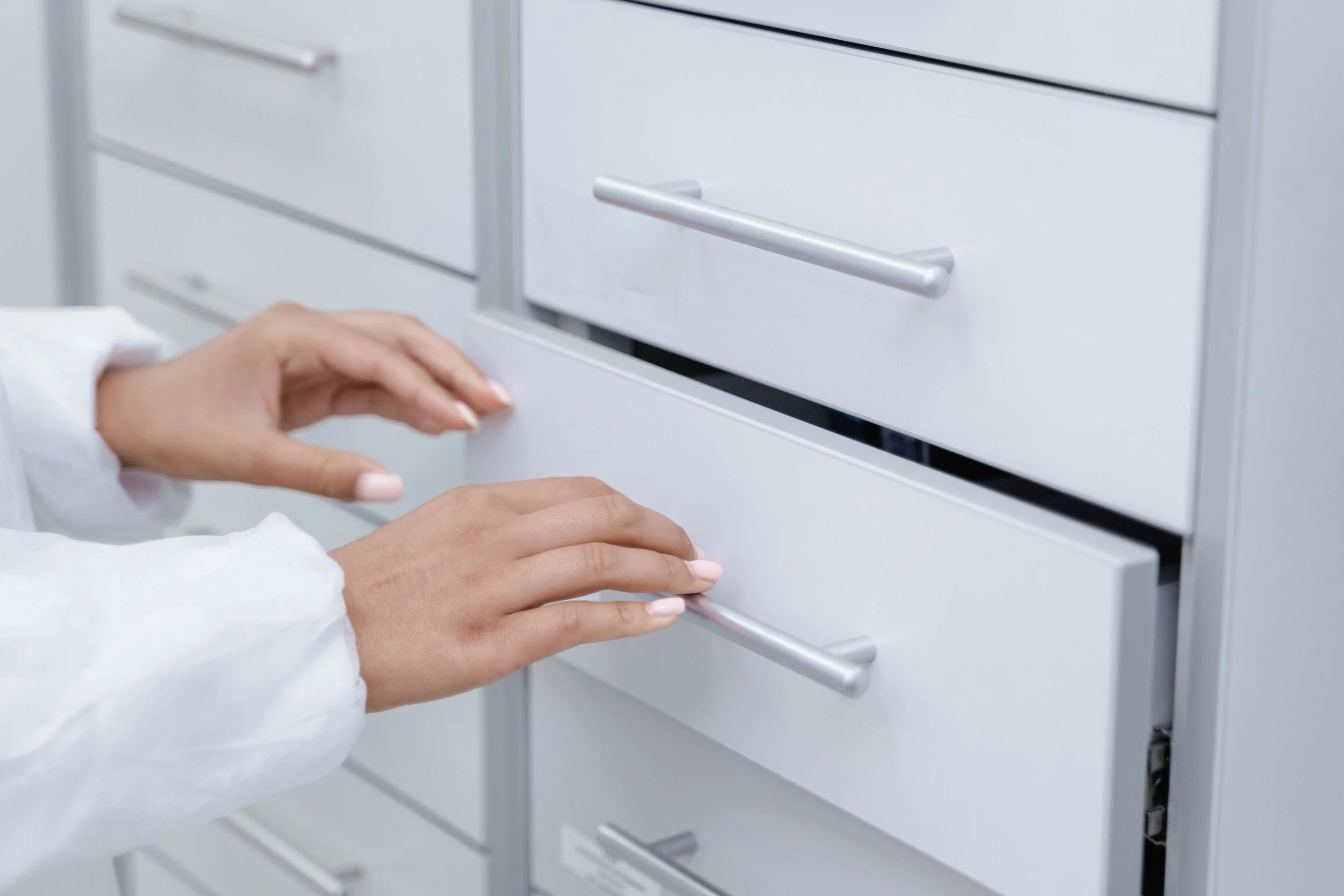
Room preparation often gets treated as a final job. The problem is that this means it gets squeezed between everything else. That is not a good way to do it. A better approach is to make the room itself do some of the organising. Store equipment in consistent places and label drawers clearly. As mentioned earlier, keep the most frequently needed items together. If an item has to be replenished, make the shortage visible.
It can also help to think one appointment ahead. If you know what the next patient needs, prepare the room before the previous patient has completely left whenever this can be done safely and appropriately.
Conclusion
Once your office is organised, don't assume you're finished forever. As your systems evolve, so will your organization. When in doubt, pay attention to the things staff still complain about. Ask your team what wastes their time. This gives you a direct way to solve a problem. You may get practical answers. Once you approach it that way, your ordinary work gets easier, so your staff can spend more of their attention on the people who actually came through the door.

How To Organize Medical Records At Home For Elderly Parents
Accurate record keeping often proves crucial to maintaining balance and organization. However, in the case of medical documentation, said endeavor could be life-saving.
That said, such endeavors are not always simple and often require work. Said efforts could prove especially challenging for older persons.
Medical Records Overview
In essence, medical records can be defined as any documented health-related testimony.
Specific examples include physician summaries or notations concerning a patient's condition, the results of diagnostic procedures, readings from important screenings like blood sugar, blood pressure and systemic cholesterol concentration tests, medication prescriptions, referral letters or correspondences from one medical practitioner to another regarding a specific patient's care, and insurance papers.
The Importance Of Medical Record Maintenance
Organization
Many young and healthy people receiving simple evaluations like routine checkups will accumulate health records from an early age. As said individuals grow older and encounter potential health issues, this documentation will steadily increase.
Therefore, data such as reports, scans, readings, and prescriptions can pile up quickly and precipitate trouble like disorganization, misplacement and clutter. Keeping this documentation in order prevents these potential perils.
Emergency Situations
Events such as sudden major illness or a serious accident might necessitate emergency medical intervention. When these circumstances arise, the subject in need may not possess the physical or mental capacity to recall important health details or gain access to pertinent medical documents.
In such cases, they or attending healthcare providers would need to call upon trusted family members or other close associations to access said information. However, if records are scattered, disorganized, or their whereabouts are unknown, emergencies could rapidly morph into tragedies.
Ergo, meticulous record keeping enables fast and efficient access should conditions warrant such a response.
Legal Proceedings
Occasionally, physicians, medical facilities, pharmacists, and other persons employed in the healthcare industry make mistakes. Sometimes, those victimized by such errors encounter significant, possibly life-altering physical and biological maladies.
In response, stricken patients might opt to pursue civil action against the parties alleged of executing this negligent or malfeasant behavior. However, success in such proceedings requires prospective plaintiffs and their legal representation to provide clear and abundant evidence proving said claims.
Diligently kept and carefully stored records could appreciably increase one's chances of garnering favorable results.
Tips Designed To Help Older Persons Maintain Medical Records
Place Materials In Binders Or Notebooks
Oftentimes, healthcare documentation is a large collection of papers. If not properly kept, loose papers are easily lost and susceptible to ripping and beverage spills that could smudge important written data.
Placing said items into binders and notebooks protects these records from sustaining such damage. Moreover, binders and notebooks are typically small and can often fit neatly into boxes, cabinets, closets, and other storage locations.
Organize In Accordance With Condition
Unfortunately, a discernible percentage of elderly persons have more than one notable medical issue. Their younger relatives or loyal caregivers could organize records in accordance with said maladies.
For example, a specific subject might have heart disease and diabetes. The records for these ailments should be kept in separate folders, computer files, or any other preservation method.
Moreover, said documentation should be labeled and contain all pertinent material such as the names and contact information for the healthcare providers treating said problems, associated medications, and medical reports about each respective condition.
Consult With Doctors
Caregivers or loved ones tending to an older individual are strongly encouraged to consult with said subject's healthcare providers. Granted, doctor patient confidentiality mandates might inhibit physicians from disclosing certain bits of information to other persons.
However, a trusted relation could offer themselves as a go-to individual in emergency circumstances or act as a conduit when the patient might not understand specific medical directives.
Get Educated
Caregivers are vigorously urged to educate themselves about the ailments elderly loved ones have been diagnosed with. Numerous older individuals do not like to burden younger relatives and may be reluctant to disclose important information.
However, caretakers can circumvent this potential problem by learning everything they can about the malady in question, the specific treatment options that might be employed, and the common symptoms to look out for.
Encourage Technological Usage
An appreciable number or older persons are hesitant to utilize modern technology. However, items such as laptop computers, iPads, and mobile phones often render the medical record keeping process more manageable. Ergo, younger health-maintenance overseers are firmly urged to teach their elders how to properly use these technological devices.