

A resource for those seeking information on organizing and transforming spaces.
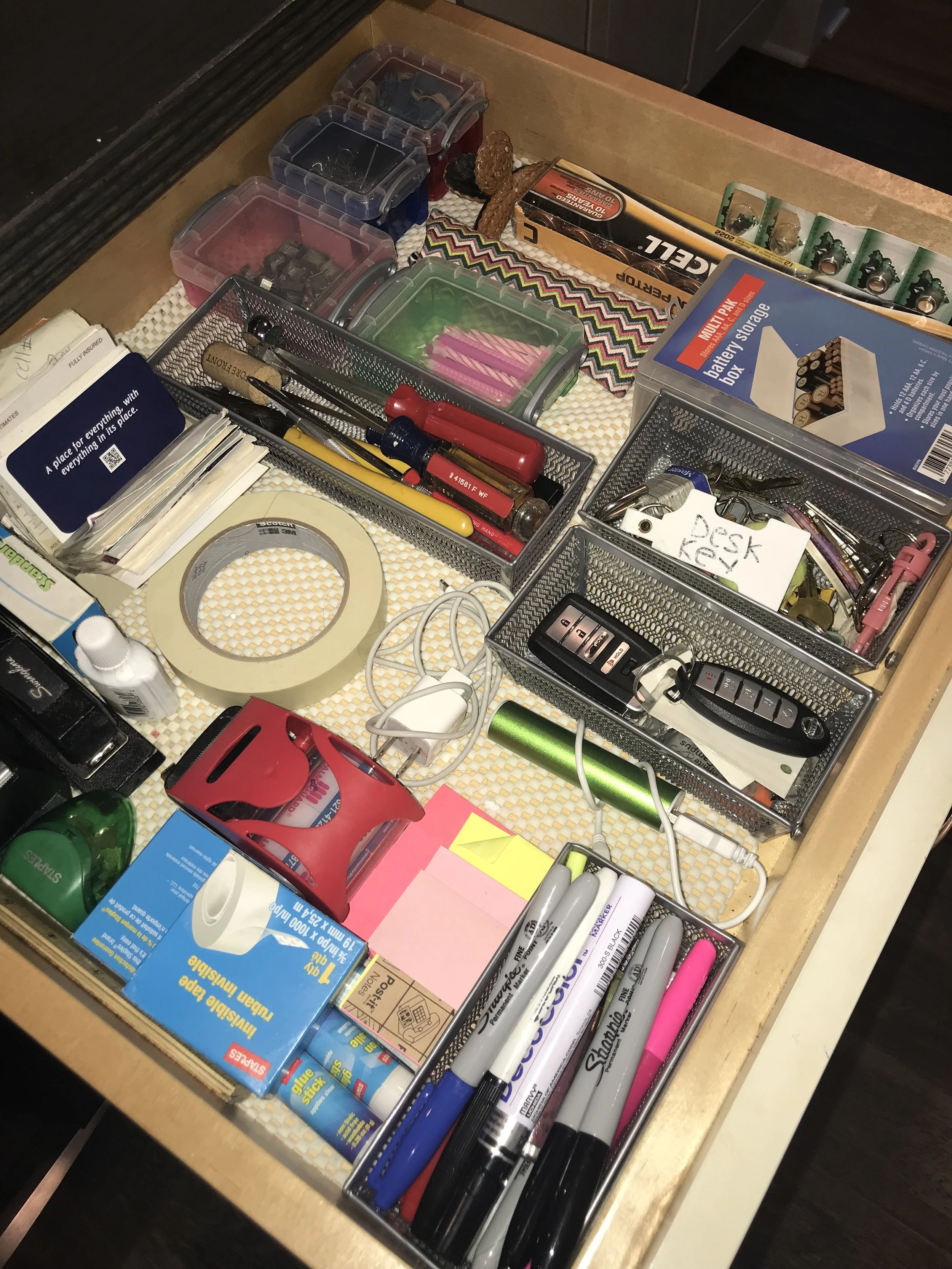
Say Goodbye to the Junk Drawer
You need to replace 3 AAA batteries. You slowly open your “junk” drawer hoping everything does not fall out. Filled with pens, pencils, rubber bands, tape, batteries, birthday candles, business cards, buttons, take out menus, and extra keys to name a few, you rummage around pushing and pulling the items to hopefully find the batteries. You can’t find them and frustrated you shut the drawer. You are now on your way to the nearest convenience store to buy more AAA’s. You promise yourself that one day soon you will organize the drawer. Sound familiar?
You need to replace 3 AAA batteries. You slowly open your “junk” drawer hoping everything does not fall out. Filled with pens, pencils, rubber bands, tape, batteries, birthday candles, business cards, buttons, take out menus, and extra keys to name a few, you rummage around pushing and pulling the items to hopefully find the batteries. You can’t find them and frustrated you shut the drawer. You are now on your way to the nearest convenience store to buy more AAA’s. You promise yourself that one day soon you will organize the drawer. Sound familiar?
All homes need a drawer to put odds, ends and tools that do not quite have a home anywhere else based on how often we use them. Usually this type of drawer in found in the kitchen or office. But is this really junk? These items are useful and necessary. At House to Home Organizing we prefer calling it a utility drawer where you can easily find your daily necessities.
Here are some tips to organize and de-clutter these drawers:

Take everything out. Wipe drawer clean. Let go of things which have been never used and are easy to get again. For example, the soy packets from the Chinese restaurant that have been sitting there for 6 months. Recycle old and unused business cards and take out menus. (Most take out menus are online these days) Go through spare keys and make sure you label what door or lock they go to. Recycle the questionable keys. Do all the pens work? Do the pencils have erasers.
Sort and group like items. All rubber bands together, paper clips together, pens, pencils, tape, batteries, keys, birthday candles, etc. Make piles so you can see quantity. Keep a reasonable amount of each item. For example, if you have 10 rolls of tape maybe 8 can live in a backup area in your home. Quantity will determine the size of the containers you purchase.
Measure the width and height of the drawer. Decide what type of systems you will use to divide the drawer. Need ideas? Look online. You can buy small plastic baskets, mesh trays, wood organizers, clear Lucite trays, the options are endless.
Here are a few examples:
Once you have purchased the storage systems the fun begins! Arrange the items in their new containers. Now, when you open the drawer you can easily find what you are looking for. No more rummaging around and being frustrated!
Maintain your organization. Go through the drawer weekly. Up keep is crucial to prevent clutter from returning. Also, if there are any items in the utility drawer that you don’t use frequently it may be time to move them to a remote location.

Invisible Organizing
Organizing is often more than meets the eye.

We have all heard a picture is worth a thousand words. And never before has that saying been more true than in the brave new world of social media. Professional Organizing lends itself to amazing before and after pictures. There is no doubt that you get a wow factor transforming a garage filled with 30 years of clutter into a useful space with room for the cars and lined with finished systems. However, sometimes the before and after pictures can look exactly the same. How is that possible? Good organizing isn't about Instagram, it is fundamentally about being able to find what you are looking for, so you can be productive and efficient.

In most cases people don't have chronic or extreme clutter, they have busy lives and lack of systems (containers, baskets, hooks, etc...) They may have a cleaning person or simply want their surfaces free from clutter. In these cases the before picture is often the same as the after picture until you open the drawers and closet doors. When people get the house ready for guests or just want a clean look they tend to turn to "make it go away" areas, hidden from view. These black holes give the space a neat clutter-free look but don't tell the whole story. At House to Home Organizing we usually start projects by focusing on the closets, garage, attic or basement. We want to free up usable space in order to create homes for your items to live. We want you to be able to find what you are looking for and that means looking at the whole picture. Additionally, by emptying the hidden areas we can review every item in context so our clients can make regret free decisions. Great before and after photos can make people say wow, but don't forget to see the whole picture.

Interview - MaxSold
Over the years we have helped many people downsize or move and they often ask about estate sales. Yard, garage and estate sales can be tricky and sometimes not worth it. However, there are many options available for those with items to sell. We spoke with TJ of MaxSold about the resources they offer.
Over the years we have helped many people downsize or move and they often ask about estate sales. Yard, garage and estate sales can be tricky and sometimes not worth it. However, there are still many options available for those with items to sell. We spoke with TJ of MaxSold about the resources they offer.
For the busy person, what is MaxSold?

We are an online auction company that specialize in estate and downsizing sales. Think Craigslist meets eBay.
How does the process work if someone wants to sell with you?
Once you decide to hire us, everything goes like clockwork - we just need access to your place twice and our whole process takes only 2 weeks to complete:

- Cataloging: An entire day for us to photograph, describe and measure any and all items you might have to sell.
- Auction: We host the auction catalog online for 7 to 10 days and at the end the winning bidders pay for their items.
- Pick-Up Event: Two to four hours supervision of the removal of items – this typically happens two days after we close the week long online auction.
How does someone know if their items are worth it?
We do not complete appraisals as this is a pure auction-based system. We get fair market value for the items as we drive a bidding environment.
What geographic locations do you cover?
We are in 19 states and two provinces in Canada
(WA, CA, AZ, CO, TX, GA, FL, OH, VA, DC, MD, DE, NJ, PA, CT, MA, NY, RI and NH)
We are in British Columbia and Ontario in Canada
Can you share some of the interesting or cool things you have sold?

Measuring 10 ft. Span. 10 ft. long, and weighing in at over 3000 pounds, this anchor required an industrial strength crane for removal.
Found in an unused barn that was part of an estate sale in Maryland, this rusted chicken plucker was truly a unique find.
Sold as part of a Business Downsizing auction in Kingston, Ontario, this hand-made statue was a truly one-of-a-kind piece. Selling for more than $1800, this is definitely the weirdest things we've sold yet!

You can be the cream of 19th Century Society with the Surrey, sold as part of a MaxSold Estate Sale. Note: Horses Not Included.
People definitely collect weird things over the years. But who collects FOUR CPR dummies? Like one, ok fine we can get our heads around, but FOUR? Perhaps a paramedic or a CPR instructor?
We've sold several coffins at MaxSold, but this one is definitely the creepiest! It kinda looks like there's someone inside it still...

Interview - Troxes
Over the years, there is not much we haven't seen in our client's homes. However, some items we see in ALL of their homes, especially when it comes to toys & games. While there is nothing wrong with Candyland at House to Home we encourage our client's to seek out quality items that might not be so disposable. We spoke with Jonathan Bobrow about Troxes to learn more about this interesting invention.
Over the years, there is not much we haven't seen in our client's homes. However, some items we see in ALL of their homes, especially when it comes to toys & games. While there is nothing wrong with Candyland at House to Home we encourage our client's to seek out quality items that might not be so disposable. We spoke with Jonathan Bobrow about Troxes to learn more about this interesting invention.

For the busy person, what are Troxes?
Troxes are like Origami meets Lego™. They are non-rectilinear (not square or cubic) paper building blocks. No scissors. No tape. No glue.
Note: Don’t be fooled by the paper aspect, they support over 500 times their weight and by thinking literally outside of the box, they mimic structures found in nature like the crystalline structure of diamonds and fold just like our proteins. They inspire new ways of thinking, counter to the status quo and opposed to the right angles we are all too familiar with.
What is your background, how did you create Troxes?

I grew up with an artist mother and an educator father. I have always been a passionate artist as well as math lover, leading me to study mathematics in college and later design and media arts. I applied these talents to art installations, websites, game design, product design, and interactive museum installations. Inspired by the creative humanitarian and technological efforts of Nicholas Negroponte, I decided I wanted to pursue my own interests with inventing curious devices for social change. I applied and was accepted to the MIT Media Lab. It was my first week in attendance, in a class called How To Make (Almost) Anything, taught by Neil Gershenfeld, and my assignment was to make a press-fit kit (something that would hold together without adhesives or screws) only out of cardboard. I thought it would be neat if my design not only press-fit together, but once it was done press fitting, it could press-fit once again in a modular way. I had seen something similar created by Jef Raskin in the 1970s that built from squares and I thought, what if it were based on triangles. The projects was just a first week assignment and Troxes were essentially invented at that point, however I enjoyed the process of making them so much, I decided to shrink down the design so I could make many more (like hundreds… or thousands) and continued to iterate the design on my nights and weekends. Some of the best traits of Troxes were happy accidents as well as carefully considered design.
What are some of the popular creations for Troxes?

The first creations that anyone makes with Troxes are typically the Platonic solids (Tetrahedron, Octahedron, Icosahedron). From there, people tend to invent their own shapes, as well as combine units together to build larger structures or figurative forms. We package a Trox Fox Kit and a Trox Penguin Kit, so those two are popular creations by design, but people always want to create their own forms. Most recently, a classroom working with Troxes was particularly determined to invent the Trox Turtle, a welcome new member of the Trox critter family and I have seen a unicorn appear on a number of occasions. Me personally, I dream of abstract and architectual designs with Troxes.
What is Move38?
Move38 is a design and game company based on my research at the MIT Media Lab. The name however, has a fun backstory, so I’m glad you asked. In 2016, one of the worlds best Go Players, Lee Sedol, faced off against a computer AI, AlphaGo, in a 5 game match of Go*. Due to its complexity and dependance on player creativity, it was once thought that a computer could never beat the best human Go players. There was only one moment in all 5 games that stirred conversation after the showdown. In the second game, AlphaGo, made a single move that no professional player predicted. It caught all of the commentators off guard, as they had never seen such a move. The move, as it turns out, was a very good one–it not only threw off Lee Sedol, but secured the win. This was the 37th move of that game and so Move38 represents the human response to playing with systems.
We believe the kinds of systems we create, participate in, and are composed of are more complex than ever before, and through new kinds of play, we can raise a generation of systems thinkers.
*Go for reference, is played on a 19 by 19 board, meaning after the first move, there are 361 possible starting positions, and when the player makes her second move there are over 46 million possible arrangements. Needless to say the complexity of the game grows factorially and there are sadly not enough atoms in the universe to represent all possible game outcomes.

