

A resource for those seeking information on organizing and transforming spaces.

5 DIY IDEAS TO TURN YOUR ROOM INTO A MYSTERY ROOM
Amidst physical distancing and Covid-19, it is understandable that escape room enthusiasts would want a more safe and sanitary experience at home. Even if your reason for a DIY mystery room is to have fun at home, then don’t worry we got you covered.

Amidst physical distancing and Covid-19, it is understandable that escape room enthusiasts would want a more safe and sanitary experience at home. Even if your reason for a DIY mystery room is to have fun at home, then don’t worry we got you covered.
Mystery rooms are great fun and can easily be constructed within your house. Be it a temporary room or a permanent room. Preparation is the key to a DIY mystery room.
Before you begin planning your mystery room/escape room, it is important you outline the purpose for it. While the general idea is to have fun, it can also be an educational room for kids, a party room for adults, and a fun puzzle-solving time with family.
Once the desired purpose is clear, set a background story for it, escape rooms can feel like a tedious puzzle-filled cage without a good background story.
Next, ensure you have a theme and characters to along with the story. Is a set in the 1950s or 2010s? having a theme and set of characters will help in ensuring that the puzzles are relevant and do not break immersion.
With characters and themes out of the away, plan your puzzles. This is perhaps the most difficult out of all the preparations. Deciding on puzzles relevant to your escape room is important. you don’t want a puzzle involving mobile phones in a 1970’s murder escape room. that breaks the immersion.
Another key thing is to not overdo puzzles. Ensure that the experience is fun and not brain-scratching and agonizing experience. Ensure that the puzzles are not too difficult or easy. Place proper clues around.
With the basic preparation done, let us look at the 5 (five) DIY ideas to turn your ordinary room into a fun-filled mystery room/escape room.
1. LOCK & KEY
Lock and Key are some of the most essential items in a DIY escape room. locking things such as cupboards, dressers, or boxes containing clues gives a sense of purpose. Incorporating puzzles that reward you with keys instantly allows for a great search and find mission.
Simple, cheap, and effective, LOCK and KEY are available almost in every household and are great items for making interesting puzzles.
Using small padlocks to lockboxes containing clues or using a combination lock as part and parcel of a puzzle, locks have great versatility, locks and chain can even be used to seal the escape room to help with immersion.
As a safety feature, always ensure to keep spare keys with the room master or in a place accessible in case of any emergency.
2. HIDDEN ITEMS
Hiding items around the room can be great fun, finding the last piece of the puzzle can be gratifying. Hiding items behind locked doors, cabinets, dressers, or inside them is a great Idea.
Items such as passcodes, keys, clues, messages, or even a whole new puzzle can be hidden for the players to find. If you have a safe with passwords or with a traditional locking mechanism, then various things can be hidden in them.
A great idea to hide small things is to put them into other items such as balloons, bottles, out-of-reach ceilings, pillow covers.
Various objects such as plastic balls, cups, and holders can be cut or designed to hold keys in plain sight without raising suspicion.
3. WORD PUZZLES
Playing around with words is amazing, isn’t it? We all have come across a word puzzle at least once in our lifetime. However, word puzzles are a staple for escape rooms.
A word puzzle in the form of riddles and questions can be used to provide either clue or hint towards another puzzle. Writing down on small pieces of paper that can be hidden will give you an opportunity to search every nook and cranny.
Word puzzles can be made using jigsaw pieces with words written behind each piece. Requiring players to solve the jigsaw to get the next clue.
Alternatively, keep random bits of paper with a single or more alphabet hidden. The player will have to solve and make sense of these alphabets to get access to another clue/key.
Various cut-outs of the crossword puzzle can be used as hints or even puzzles. Combination puzzles requiring alphabets to align (cryptex) to form a word are another great idea that can be used.
Taking inspiration from ‘The Riddler’, Batman’s nemesis and an expert in riddles are suggested for maximum effect.
4. NUMBER PUZZLES
Just like word puzzles, number puzzles are complementary in that they can be used with lock and key mechanisms, with word puzzles, and any other riddle that is used. A combination lock can be used in which only opens with specific numbers.
A table can be created with each alphabet corresponding to a different digit. These digits can further be access codes to secret safes or items.
Various objects can be labeled with alphanumeric language. Puzzles involving the player solving and decoding secret codes from alphanumeric to numeric or alphabets can be a fun and easy DIY puzzle.
5. HIDDEN CLUES
Clues are like catalysts in an escape room. without clues, escape is slow and boring. To hide clues or to have hidden clues in a DIY escape room, a small piece of paper can be taped on any number of objects hidden out of the field of view. It is the oldest trick in the book.
Taping keys or that final jigsaw puzzle piece underneath a dresser that when found leads to another puzzle that when solved leads to the hidden item inside a pillow that when used…. you get the point. Clues can simply be hidden in plain sight with all your stuff in dressers or pen stands or places cluttered with items.
Make sure your clues even if found early can only make sense when they are found correctly and not by skipping puzzles. This will ensure players stick to the traditional way of solving puzzles to advance. Sequencing your clues and predicting the order of them being found is important.
CONCLUSION
REMEMBER, Escape rooms are immersive and fun, do not go overboard by creating impossible puzzles and tough clues. Keeping it simple is the number one rule. Ensure everyone abides by the rule as cheating or bypassing stages/puzzles will break the immersion and defeat the purpose.
With these ideas, you should be able to cater to people of all ages at your house in your room. with little preparation, you can experience a mystery room now!

Guest Post - 4 Summer Safety Tips for Children
Summers are for bonding and creating memories as a family. However, it’s difficult to relax if you’re worried about your children’s safety. Luckily, the following precautions can protect your kids and put your mind at ease.

Summers are for bonding and creating memories as a family. However, it’s difficult to relax if you’re worried about your children’s safety. Luckily, the following precautions can protect your kids and put your mind at ease.
1. Apply Sunscreen
With so many fun outdoor activities to enjoy, your kids will likely be outside all summer. Protect them from sunburn by applying sunscreen 15 to 30 minutes before they head out to the pool or trampoline.
Use sunscreen with an SPF of 30 or higher and reapply about every two hours. If they’re swimming or sweating, apply another layer or put on some protective clothing to prevent burns.
2. Secure the Pool
Every day, about two children aged 14 or younger die in unintentional drowning incidents. Therefore, whether you have kids or not, it’s important to put a fence or other barrier around your pool. Doing so will prevent the neighbors’ youngsters from wandering onto your property and accidentally falling in.
3. Mind the Garage Door
Children and parents should also practice safety when playing in and around the garage and driveway. At least 85 kids have suffered permanent brain injuries or died in automatic garage door accidents. However, teaching kids to be aware of their surroundings and keeping the door’s path free of toys can effectively keep your family safe.
4. Protect Against Bugs
While observing backyard bugs can provide a unique learning opportunity, insects can also bite and sting curious children. If you want to minimize the number of dangerous creepy crawlies in your yard, try sprinkling your garden with diatomaceous earth or natural, non-toxic pesticides.
These simple solutions will keep insect populations in check so your kids are less likely to encounter six-legged threats.
Fun in the Sun
By taking the right precautions, you and your kiddos can have a safe and memorable summer. Take advantage of the bright sunshine, cool breeze a
Author bio: Rose Morrison is the managing editor of Renovated, where she offers advice on home renovation, maintenance, and organization.nd slow-paced lifestyle now, because your little ones will be back in school before you know it!

5 Remodeling Ideas for A Clutter-Free Kitchen
If you desire a clutter-free kitchen that is more conducive to your lifestyle, consider these five kitchen remodeling ideas.

Tiny kitchens don’t seem like a bad idea in theory. When you think about it, how much space do you really need to cook a meal? It turns out that you actually will need more than expected.
Many times, having a tiny kitchen can be more difficult than anticipated. After all, there are a lot of things that go in the kitchen that we don’t realize. From small appliances, a gadget for every need, plus food and dishes for the entire family.
Having a tiny kitchen means that space gets easily cluttered, provides limited space for cooking large meals, and prevents you from being able to socialize and gather in the kitchen.
If you desire a clutter-free kitchen that is more conducive to your lifestyle, consider these five kitchen remodeling ideas.
1. Flooring

Flooring can make or break a cluttered look. Even if everything is completely organized, if the floor is busy, a small kitchen will still look cluttered. Consider simple flooring like vinyl kitchen flooring in a solid color. We will talk about colors down below, but simple colors or patterns when it comes to flooring are best for a clutter-free kitchen. Flooring is a vital part of tying a kitchen all together, making the space usable, and easier to clean.
2. Organization
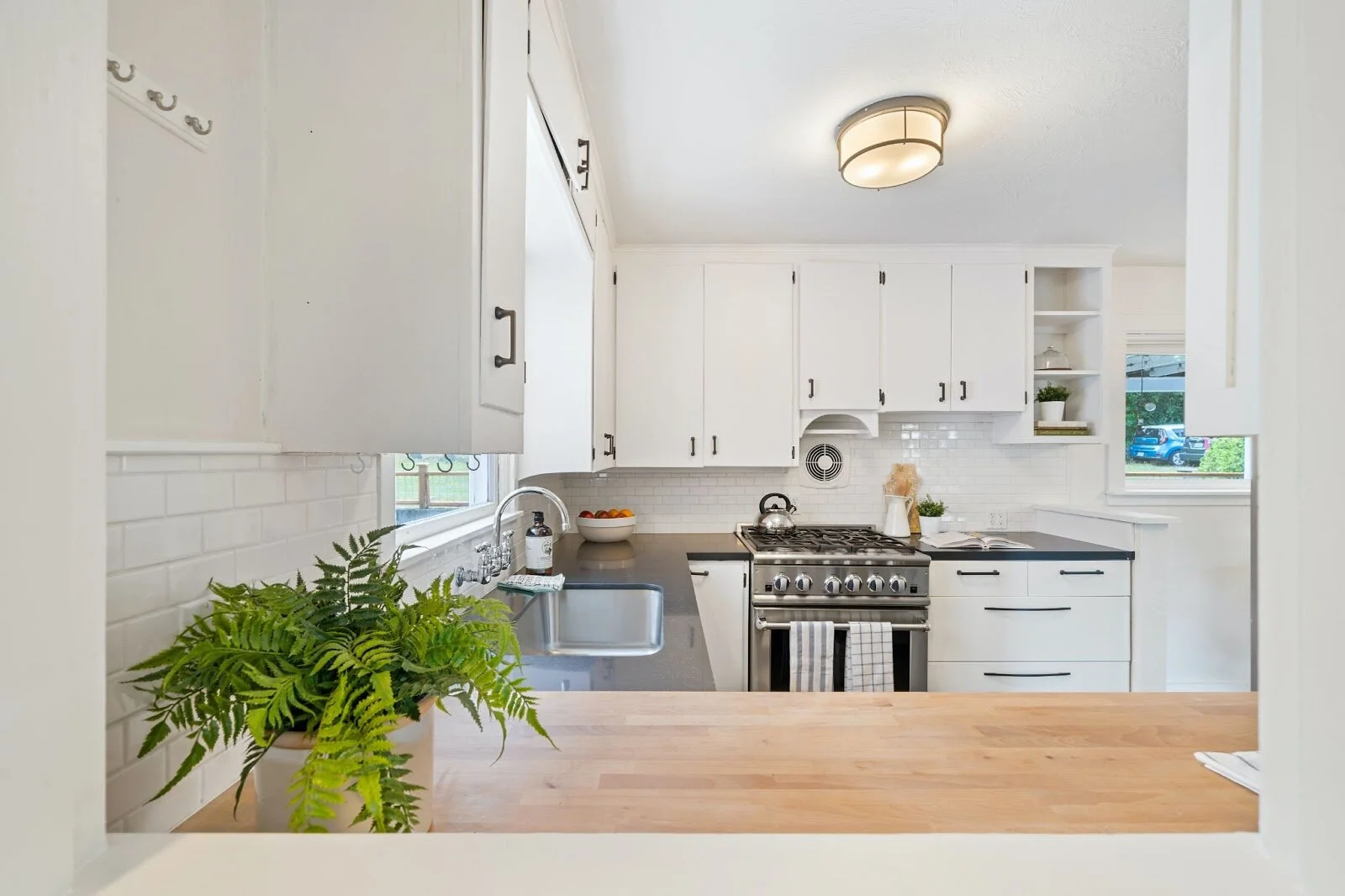
Let’s face it-- if things aren’t organized, they are always going to look cluttered. When remodeling your kitchen, including elements of organization is key. Maybe you choose taller cabinets so that more things can be off of the countertops, or you could remodel an unusable space and make it into built-in shelves for better storage.
Another idea is to rearrange the order of the kitchen. For instance, for maximum efficiency, the sink, the fridge, and the stove should be in a triangle shape. Having everything in the best place possible can really help with clutter because you no longer have to keep things near certain areas for convenience.
Keep in mind to use every little space you can from additional storage on an island to the space above the fridge. Organizations can be implemented in a variety of ways.
Regardless of the layout of your kitchen, there is always room for improvement using remodeling when it comes to organization.
3. Fixtures

Remodeling your kitchen to have more minimalist fixtures can be a simple upgrade to make your kitchen look clutter-free. Fixtures include everything from lighting and faucets down to the drawer pulls and handles on the cabinets. Be sure that at the end of your kitchen remodel that you replace all the fixtures to update them. Choose fixtures that have simple lines and are the proper size to avoid a cluttered look. Don’t forget to have plenty of light to make the space feel more open.
If you don’t have a window, consider having a few different light sources like different combinations of an overhead light, under cabinet lighting, or pendant lighting.
4. Colors
Colors, patterns, and textures do a lot for the look of a space. When remodeling your kitchen, go with light colors to reflect light and simple, classic patterns to avoid the cluttered look. Add a subway tile backsplash for a quick remodel project that will bring your cluttered kitchen to life. Also be sure that the look of fixtures, walls, backsplash, cabinets, and flooring is all cohesive so that the eye isn’t drawn to as many places at once giving the appearance of clutter. You could even consider going with a monochrome look where everything is different shades of the same light color. For instance, shades of gray, white, or beige.
5. Open Up Space

One of the biggest things you can do to remodel and create a clutter-free kitchen is to open up space. If there is a wall to take out or additional space in the dining room that you can use, you should consider opening up that space. Adding more space in an area decreases the look of clutter because things can be spread out more. If you can’t gain any more space in the kitchen, then consider creating flexible spaces.
Flexible Spaces
Flexible spaces are exactly how they sound. Spaces that can be used for multiple purposes. One flexible space that is common in the kitchen is a kitchen island. Many larger kitchens have permanent kitchen islands, but even if you don’t have space for a traditional kitchen island, a prep cart can do wonders for creating more space.
Additionally, you might add a countertop and cabinets in the dining room which can be used as a prep station, a dining bar, and storage all in one. When remodeling your kitchen, think about how you can create flexible spaces that can help declutter and open up space.
Need Help Decluttering?
Achieving the goal of having a clutter-free kitchen can seem like climbing a mountain. If you are struggling with decluttering, call House to Home Organizing, your expert in home organization. They are ready to help!

Common Types of Garage Accidents You Can Prevent With Proper Maintenance
Many home accidents happen in the garage, and that's no surprise. Often used for storage for large vehicles, countless types of tools and chemicals, plus a range of other objects that have no other place in the home, there’s a lot that can go wrong. Each is an accident waiting to happen. When you're aware of the following potential garage accidents, though, you can take action to prevent them.

Many home accidents happen in the garage, and that's no surprise. Often used for storage for large vehicles, countless types of tools and chemicals, plus a range of other objects that have no other place in the home, there’s a lot that can go wrong. Each is an accident waiting to happen. When you're aware of the following potential garage accidents, though, you can take action to prevent them.
Slips and Falls
The garage floor can become slippery from vehicle fluids, water brought in from wet roads, and more. Hosing down the garage floor frequently and then leaving the door open for a few hours for it to dry is the best way to keep your garage clean and fresh while preventing slip and fall injuries. Engine oil and other greasy spots may require scrubbing or a specialized cleaner to remove.
Fires
Vehicles can sometimes catch on fire, depending on the conditions, and so can many of the other things commonly stored in a garage. Keep in mind that paint, wood, paper, gas, and other flammable products in your garage are a safety hazard for your family. Each flammable material should be stored properly to maintain the safety of the garage. You may find it best to move some things to a storage building that isn't connected to your home. Better yet, get rid of unneeded flammables.
Garage Door Accidents
Regular inspection and garage door repair are crucial to safe use of an automatic garage door. Damage can happen when you hit the door with your car, when moving large items, or simply when old components wear out. When you notice damage, contact a reputable garage door repair company. Trying to fix the door yourself may result in some safety features not working properly. Tiny fingers can be trapped under a closing door or a pet can be crushed when safety features malfunction.
Chemical Exposure
Part of garage maintenance is taking care of chemicals you store there. Get rid of chemicals and fluids you don't need, clean up spills, and make sure anything toxic is locked up inside a high cabinet to prevent accidental access by children or pets. Be sure there is enough ventilation in your garage to prevent airborne chemical exposure too. Also, avoid running a car in a closed garage, which can lead to carbon monoxide poisoning.
The garage may not be the best place to store the things you don't want in your house. Whatever you do with your garage, however, make sure you're doing all you can to prevent injury by keeping it clean and well-maintained. It may take a bit of effort, but you'll never regret doing everything possible to prevent garage injuries and accidents.

