

A resource for those seeking information on organizing and transforming spaces.

Interview - Genius Scan
We have a lot of clients who ask us about going paperless and we have a system for that process. However, deciding what specific tools to use going forward can be challenging so we spoke with Bruno with Genius Scan about some options.
We have a lot of clients who ask us about going paperless and we have a system for that process. However, deciding what specific tools to use going forward can be challenging so we spoke with Bruno with Genius Scan about some options.
For the busy working parent, what is the easiest way to explain what Genius Scan is?
We like to describe Genius Scan as a real scanner in your pocket. But in practice, it's more powerful than that: with a real scanner, you get a clean document. Then you need to get it somewhere. Genius Scan packs everything in the same app: in a couple taps you will get a clean document and export it wherever you need it.
More concretely, Genius Scan is super helpful to digitize a lot of everyday-life documents. For instance, you can scan documents for the school teachers, doctor's prescriptions … a lot of parents use Genius Scan to archive the family's important paperwork and have it at hand at all times.
Can I take a photo with anything besides my phone and does the physical size of my original paper document matter?
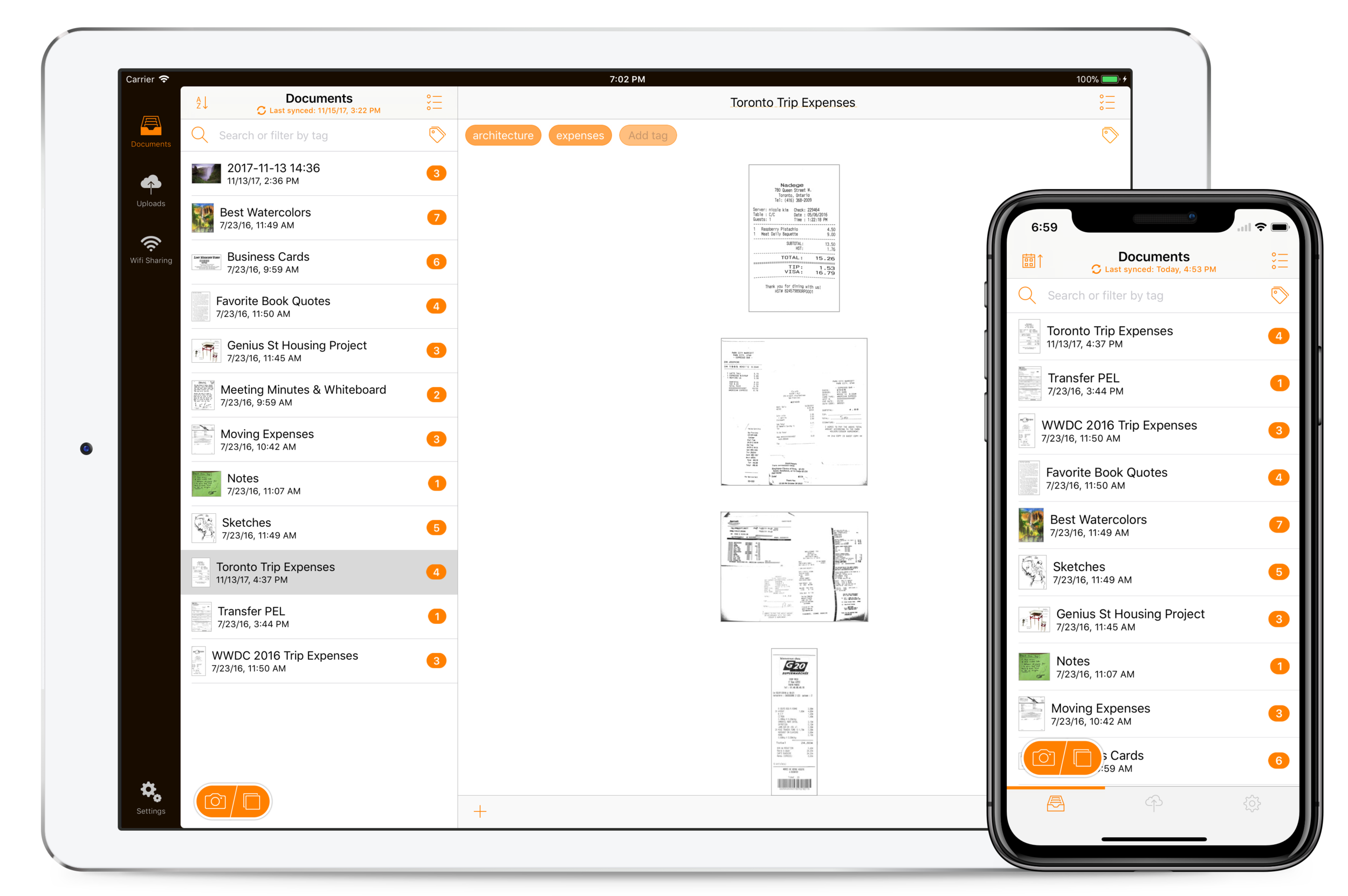
Genius Scan is available on iOS and Android, and is designed for both phones and tablets. The closer your can be to the document, the higher the resolution will be. So you will get super-high resolution scans if you scan a receipt or a Letter-size paper. If you scan a very large blueprint, the results might be less good. In all cases, it's very important to have a good lighting environment.
When I scan a piece of paper, where does it live?
The documents you scan are stored on your phone. Then, you can decide to send them somewhere. The most common option is to send it by email. But Genius Scan integrates with all the major cloud storage services, so it's very easy to archive your documents in, say, Dropbox.
Just recently, we also launched an optional service called Genius Cloud, which let you sync your documents between your devices and back them up. We recommend using it if your documents are important as it protects you in case you lose your phone, break it or accidentally delete a document.
How do I find what I'm looking for in my scanned paper?
Genius Scan lets you easily organize your documents with tags and Smart Document Names (you can name a document based on the city you scan it in, or based on a client's name). In the future, we plan to offer OCR services to let you search your documents.
What are the different types of Genius Scan and the fees, is there a space limit?
Genius Scan is free and fully functional. Just try it! You can unlock Genius Scan+ for a one-time fee of $7.99. This unlocks premium features such as the export to Box, Dropbox etc., Smart Document Names, automatic background export, Touch ID security. Last, you can opt for Genius Cloud. It's a subscription ($2.99/month or $29.99/year) which offers unlimited and automatic backup and synchronization for your documents, plus all the features of Genius Scan+.

Interview - LEC Massage & Wellness
As one can imagine many of our clients are busy with work and children and therefore they experience a certain amount of stress in their daily lives. As organizers we can help them take back control of their space, but we look to others for other kinds of relief. We spoke with Lourdez Castro, HHC, LMT with LEC Massage & Wellness about other ways to reduce stress.

As one can imagine many of our clients are busy with work and children and therefore they experience a certain amount of stress in their daily lives. As organizers, we can help them take back control of their space, but we look to experts with different backgrounds for other kinds of relief. We spoke with Lourdez Castro, HHC, LMT with LEC Massage & Wellness about other ways to reduce stress.
How did you get started as a massage therapist; what is your background?
My first real experience with massage was back in 2004. I've gotten massage before that but only a few times and it was years in between each until 2004 when I was diagnosed with Non Hodgkins Lymphoma. The cancer center I went to had an integrated program that offered massage and reflexology. I had a few sessions during treatments and it made a difference for me. I was less stressed about my treatments. When I was diagnosed again in 2007, I took full advantage of the program and had weekly massages during treatments and noticed that I was able to tolerate chemo sessions better and I was more relaxed and less tense. I realized that massage therapy was an organic, natural way to feel better. It wasn't till 3 1/2 years later that I realized I wanted to help people feel better and enrolled in massage school, while still working full time. I graduated and was licensed in 2013. I finally quit my corporate job in 2014 to dedicate my time to massage therapy full time. I started my own private practice in the middle of 2014 not really knowing much about starting a business but I wanted to massage as many people as I can. I eventually started at a new spa, Ciel Eau, in New Canaan in 2015 as a massage therapist. I still have my private business that I am growing (for now it's a mobile business) and future plans to open an office space in the Norwalk/Rowayton area.
What types of massages do you offer and why?
I offer different modalities, such as Swedish Massage (for relaxation), Deep Tissue Massage (relieve muscle tension & pain), Sports Massage (stretching & flexibility), Integrated Massage (specifically designed for you), Chair Massage (Corporate and Individual), Prenatal (relieve tension and relaxation for mom and baby) and Oncology Massage (soothing touch before, during and after cancer treatments). All these modalities help you relax, relieve tension, help reduce pain, and helps bring your body back to balance.
Do you have a location or do you travel?
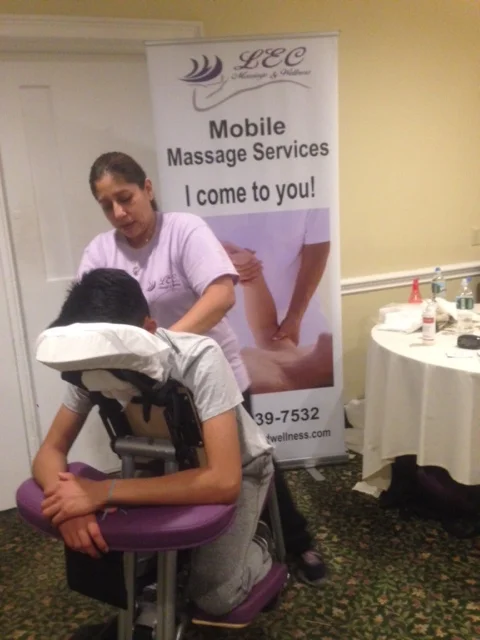
For now, I travel to my clients within lower Fairfield county. I do plan on opening an office space in the near future.
You must see people with a lot of stress, what is that like?
Most of my clients are people who work in front of a computer and busy parents with kids. That is a lot of stress on a daily basis. Technology has provided us with applications that make our lives easier but it also has provided bad habits that take its toll on our body, such as "tech neck", forward head posture from looking down on our phones all the time, which causes neck and shoulder pain to rounded shoulders and strain on our low backs from our monitors not being at eye level and slouching in our chair in front of our computers and sitting for longer periods of time. New parents also deal with low back pain from picking up the kids the wrong way and carrying heavy car seats and strollers. These are the major stress complaints I see in my clients. I love working on them and relieving most if not all of their stress after a few sessions and educating them on ways to keep the stress away.
What are some things people can do to take care of themselves in between massages?
Being more aware of your posture during the day can help lessen muscle-tension build up. This way you can adjust yourself and align your spine, take a deep breathe and release tension. Stretching your body, especially neck and extremities, helps keep you loose and flexible in between massage sessions. Having a clean healthy diet can regulate your blood sugar, fuel your muscles properly and give you more energy. Exercise helps build muscles and burn fat and keeps you lean. Of course, the best compliment to all this is scheduling regular massage sessions with me.

Interview - Campus Quilt Company
Our clients are always asking us what to do with their vast number of old t-shirts, so we asked Megan with the Campus Quilt Co. for some solutions.
Our clients are always asking us what to do with their vast number of old t-shirts, so we asked Megan with the Campus Quilt Co. for some solutions.

For busy homeowners, how would you explain Campus Quilt?
Campus Quilt takes all of those sentimental items that are just taking up space in a closet and transforms them into something homeowners can use every day, a custom t shirt quilt! We understand the difficulty of parting with so many special t shirts, which is why we love transforming them into something brand new that holds all of those wonderful memories in one place.
What is the process, how do people get you the T-shirts?
To start the process, you can go on-line to www.campusquilt.com or call us at 502-968-2850 to place the order. We will take a $100 deposit per quilt and email you a design kit. We will charge the remaining balance when your quilt is complete. The kit will include an order form, some instruction sheets, and an optional layout guide. The customer is then responsible for printing off the order form and shipping the shirts to us. We ship via UPS, but customers can use whatever mailing service they prefer. However, free return shipping is included with the final payment of the quilt.
Is there a limit, any concerns about cleanliness or stains?
Not at all! Some customers prefer that we cut out stains so they are not included in the quilt, while others love the shirt because of the stain, and ask that we ensure it is included. We do ask that customers wash the shirts before sending them, but we can certainly work with shirts that have stains. For older shirts that are particularly thin, we can always add backing material (usually extra t shirt material) to ensure that the shirt is strong enough to endure the quilting process.

Are there other products available in addition to quilts?
In addition to quilts, we also offer t-shirt tote bags (using 1-2 shirts), small pillows (1-2 shirts), and large pillows (4-8 shirts).
Can people use items other than t-shirts?
We are certainly able to use a variety of materials! Essentially, we can use any material that we can get a needle through!
You must see a ton of either ugly or amazing t-shirts, any projects that stand out?
I may be a little biased, but I love every quilt we complete! Some of my favorites are the ones made from baby clothes!


Interview - Nicholas Guitars
Since we deal with "stuff" all day we try and focus on keeping items of quality that will last a long time. We spoke with Nick of Norwalk’s own Nicholas Guitars to get a sense of the custom process for well made "stuff" that rocks.
Since we deal with "stuff" all day we try and focus on keeping items of quality that will last a long time. We spoke with Nick of Norwalk’s own Nicholas Guitars to get a sense of the custom process for well made "stuff" that rocks.
What’s your background?
I have been around music since my early teens in Liverpool. I played in band's pretty much right up until I moved to the US in 1996. In the early 90's I had a number of guitars built by an outstanding English luthier and we became good friends. Spending time with him in his "shop" gave me my first taste of guitar building and over the next 20+years it slowly grew from modifying finished guitars to building kits to full scratch builds.
How do you work?

All my builds are done with hand tools, I have a table saw and band saw for roughing out, but I shape with chisels, scrapers and gouges, there's no CNC cutting or design software.
How long does it take to make a guitar?
On average about 4 months. That's from picking out a couple of raw blocks of wood to plugging an instrument into an amplifier.
How does input from the costumer work?
I want to build the instrument a customer has in his or her head (within reason). Outside of the fixed requirements like scale length and fret position, pretty much everything else is open to interpretation. So it may be as simple as a customer showing me a picture of a guitar they saw in a magazine, a color they like or it may take sitting down with a pencil and a piece of paper and sketching out a complete guitar.
I know it is hard to choose, do you have a favorite guitar you created?
Right now it would be one of the tricone "resonator" guitars. There's 100+ hours in the building of them and because of their acoustic nature, there's no electronics or amplifiers to hide behind, they either work or they don't. Thankfully they work!

