

A resource for those seeking information on organizing and transforming spaces.

There's an App for that!
The mobile app Letgo allows for easy and quick sale of your unwanted items.
Not the One from Frozen

One of the many things we often hear from our clients is that they are busy. Time can be a barrier when it comes to getting rid of unwanted items. While many organizations offer pickups for donations it can be time consuming if you want to sell items. Sites like eBay can sometimes work well for valuable items that are easily shipped. However, large pieces always present a challenge. For a long time Craigslist dominated the market but now there is a new kid in town. Letgo is a free mobile app that is very easy to use. Once downloaded you simply post a picture of the item you want to sell adding a brief description. Since you are using your phone you take and upload the picture basically at the same time. If you allow location services than even that step is taken care of quickly. What’s the catch you ask? Currently, there is no fee to list, buy or sell. In other words everything is free for now (the app is part of the tech bubble phenomenon where your stock price is huge but your company doesn't make a profit). Another option allows you to list the item for free which works well for treadmills and other large items since paying a hauling service to take unwanted items can get pricey. Since people have to come over to pick the item up it is best to make sure they bring enough help to carry the item and a suitable vehicle to take it away. You do need to be comfortable with the buyer coming to your house and if you can, it works best to have the item in the garage or outside when they arrive. Additionally, if you list multiple items try and book all the pickups near the same time as to free up your day.

Guest Post - Golf Season
As spring approaches, many of us look forward to playing golf as much as any outdoor hobby that warm weather allows us to indulge. But with the arrival of golf season comes the challenge of effectively storing and organizing golf equipment. Many struggle to keep their collection of golf gear modest in size and properly stored, creating a daily organizational headache - especially for a spouse or partner that doesn’t play. Here are three straightforward tips to organizing your golf clubs, balls and accessories in a manner that reduces clutter but still keeps you supplied and prepared for the links.
Golf Equipment: How to Reduce Clutter and Organize Effectively
As spring approaches, many of us look forward to playing golf as much as any outdoor hobby that warm weather allows us to indulge. But with the arrival of golf season comes the challenge of effectively storing and organizing golf equipment. Many struggle to keep their collection of golf gear modest in size and properly stored, creating a daily organizational headache - especially for family members that don't play. Here are three straightforward tips to organizing your golf clubs, balls and accessories in a manner that reduces clutter but still keeps you supplied and prepared for the links.
Don’t Collect Golf Clubs
Many golfers develop a habit of holding on to clubs they’ve acquired over a lifetime of play. However, with rare exceptions, old clubs are worth close to nothing. Given the pace with which golf technology advances each year, old clubs quickly become obsolete and cannot be sold for any real value. It’s also somewhat impractical to keep clubs as potential replacements for the set you actively use; the chances of losing or breaking your clubs during play is extremely small. Saving old sets for your children can be problematic as well. Before they hit their teenage years, they’ll need clubs specifically designed for kids, and once they get older they will want clubs of their own that are technologically current. Stick to one set of your favorite, most reliable clubs (USGA rules allow a golfer to carry up to 14 during play).
Exceptions? You may have two putters that you alternate between, or perhaps an extra wedge or hybrid that rotates in and out of your bag. But unless you’re an excellent golfer that plays a wide range of courses, stay away from constantly rearranging your clubs. Keep the clubs that you know you use most on the course and discard everything else. The momentary pain of parting with a club you rarely use will soon give way to contentment about reducing household clutter and committing to a stable arrangement of clubs to play with.
When it comes to older clubs with sentimental value – your mother or father’s clubs, or the first driver you ever owned – you shouldn’t feel pressure to throw these away. But you should only keep those clubs that truly have an important emotional connection to your past. As for storage, they should be considered memorabilia and placed in an area that doesn’t eliminate room for more pressing household needs.
Categorize Your Golf Balls and Keep a Reasonable Amount

There are two categories of golf balls: balls you use on the course, and “shag balls.” Balls that you bring to play with are new, made by elite manufacturers like Titleist, come in slick packaging, cost real money, and provide you with an advantage on the course. They should be stored near your clubs and added to your bag, as needed, before each round. Try to keep around 10-15 of these balls at any given time, and include as many in your bag as you will likely use in a round.
Shag balls are not for real golfing; they’re old balls, or balls made by mediocre companies, or both. Their sole purpose is in practicing your short game – chipping and pitching – either at home or at a local practice facility that allows you to chip around in a designated area. However, as these accommodations are increasingly rare at public courses, you should own shag balls only if you have a yard large enough to practice your short game in. The balls should be stored in a plastic bag or a small duffel, and placed in a dry area near the yard where you practice. You should keep around 20-25 if you practice frequently; a useful guideline is not to keep more than one bag or container of shag balls.
(As for balls to bring to the putting green, you can use the nicer and newer balls that you play with for this purpose. You will only be bringing 3-5 balls to the putting green, there is no chance of losing them, and they will not incur significant wear and tear being used to hit putts.)
Keep Only One Golf Bag and Don’t Over-Accessorize

Golf equipment consists of much more than clubs and balls; golfers also own a bag, gloves, tees, ball markers, and devices that clean your spikes and repair ball marks on greens. Most of these items do not pose an organizational challenge, as they are small and can be stored in your bag. However, holding on to an excess of these items isn’t organizationally beneficial, and will make your bag uncomfortably heavy. Invest in the universally available item that magnetically attaches a ball marker to a small device that also repairs ball marks and cleans spikes. (These are available in any golf shop and frequently come styled with the logo of the course where they’re sold). Hold on to no more than two of these; in a pinch, any coin can be used as a ball marker, and a tee can both repair ball marks and clean your spikes.
The major exception in terms of organizational convenience is, of course, the golf bag itself. Golf bags are awkward objects that can essentially only be stored standing upright in a corner. They have a strange shape and, once filled with clubs and balls, can quickly become quite heavy. The golden rule: one golf bag per golfer in your household, and that bag should be the bag that each golfer actively uses. Keeping old bags can create a clutter challenge that justifies saving an unreasonable number of older clubs. If you’re holding on to a back-up bag in case your active bag breaks, that could mean you should look into replacing it. Golf bags are durable and long-lasting, and if you’re concerned that yours will break soon, it might be time for a new one. (Today’s golf bags are made with much lighter materials, so investing in a newer model may also do your back and shoulders a big favor.)
Golf is an expensive sport, which is why so many golfers are reluctant to throw away old or excessive equipment. But an unreasonable attachment to golf equipment does nothing to help your game and will quickly devour valuable storage space in your garage, basement, or attic. Golfing is, ideally, a release from stress – don’t make it a source of stress and tension by adding clutter to your home.
Andrew Harrison is an obsessive golfer and golf fan who comes from a like-minded family of golf nuts. He has over four years of experience as a professional organizer and has caddied for ten summers at the Country Club of Fairfield in Fairfield, CT.
Is it Hot in Here?
Clients often ask us, when we begin our ascent to the attic if it is okay to put things up there. Typically, most items fair fine in the attic, but there are a few categories that should not be put in a hot attic.
Things that should not be stored in a hot attic
Clients often ask us, when we begin our ascent to the attic if it is okay to put things up there. Typically, most items fair fine in the attic, but there are a few categories that should not be put in a hot attic.
Pictures
One thing we see a lot with clients is film and photos. Heat and humidity can ruin the film and also can make pictures stick together. They don't need to be in the deep freeze, but somewhere climate controlled with no moisture. VHS & Cassette tapes don’t fair well over time either consider having them digitally converted.

Meltable
Candles and certain makeups like lipstick can melt for obvious reasons and should be stored in a cool area of the home. Additionally, some people feel that perfume and cologne last longer when kept cool or even in the fridge.
Stickies
Office supplies like envelopes and stamps will seal themselves shut in warm temperatures and best stored in cool place. Also, heat makes the fluid in batteries deplete and they should be kept cool, again some people even put them in the fridge.
Forget the Heat
Mice and water can also be issues in an attic. Storing items in cardboard boxes can lead to trouble. Plastic bins are not waterproof but should survive a burst pipe or leak. Remember the bigger the bin the bigger the headache since someone needs to carry it up and down. Try a medium bin that can easily be carried up and down by one person.

Shelf and Refrigerator Liners
A question our prospective clients often ask has to do with cleaning and if we do it. We are not a cleaning service, but in reality we aren’t going to place items back on a shelf or in a pantry without a little light dusting or a quick wipe down. In that regard we often find old or dirty shelf liners that need replacing.
Unsung Heroes
A question our prospective clients often ask has to do with cleaning and if we do it. We are not a cleaning service, but in reality, we aren’t going to place items back on a shelf or in a pantry without a little light dusting or a quick wipe down. In that regard, we often find old or dirty shelf liners that need replacing.
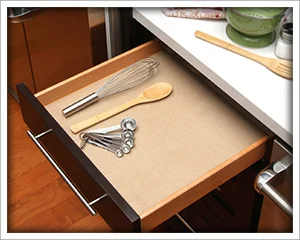
Con-Tact Grip Ultra Shelf and Drawer Liners
In our experience, these work well. They are non-adhesive which is a plus especially if you have ever tried to remove an old liner that has merged with a shelf to form an alien life form. However, the major selling point is that they can be cut easily to fit any size shelf.
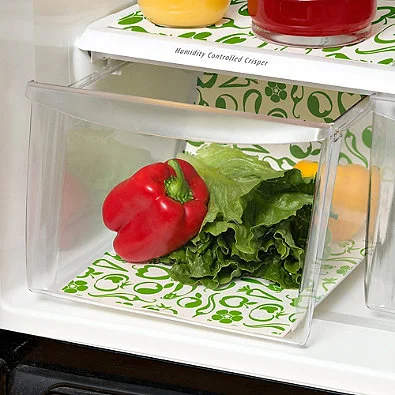
Refrigerator Liners
We have organized our share of refrigerators in our time and the shelves get dirty and in a unique way. Honey, syrup and mystery goo can be hard to remove plus the alarm goes off in your ear if the door is open too long. These liners can also be cut to fit which is a huge plus. In addition to protecting the shelves, they absorb moisture to keep those veggies crisp.
Heavy-Duty Shelf & Storage Liners
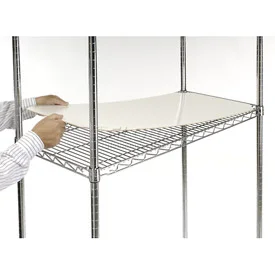
Often we encounter metal shelves in the attic, basement or garage and items can fall through the cracks. Plastic liners work really well to ensure loose items can be placed worry free on any utility shelf. They also can be cut to size and also work in the laundry room or any closet with wire shelves. If you have ever dropped items behind the washer and dryer you know the importance of getting things to stay in the proper place.

